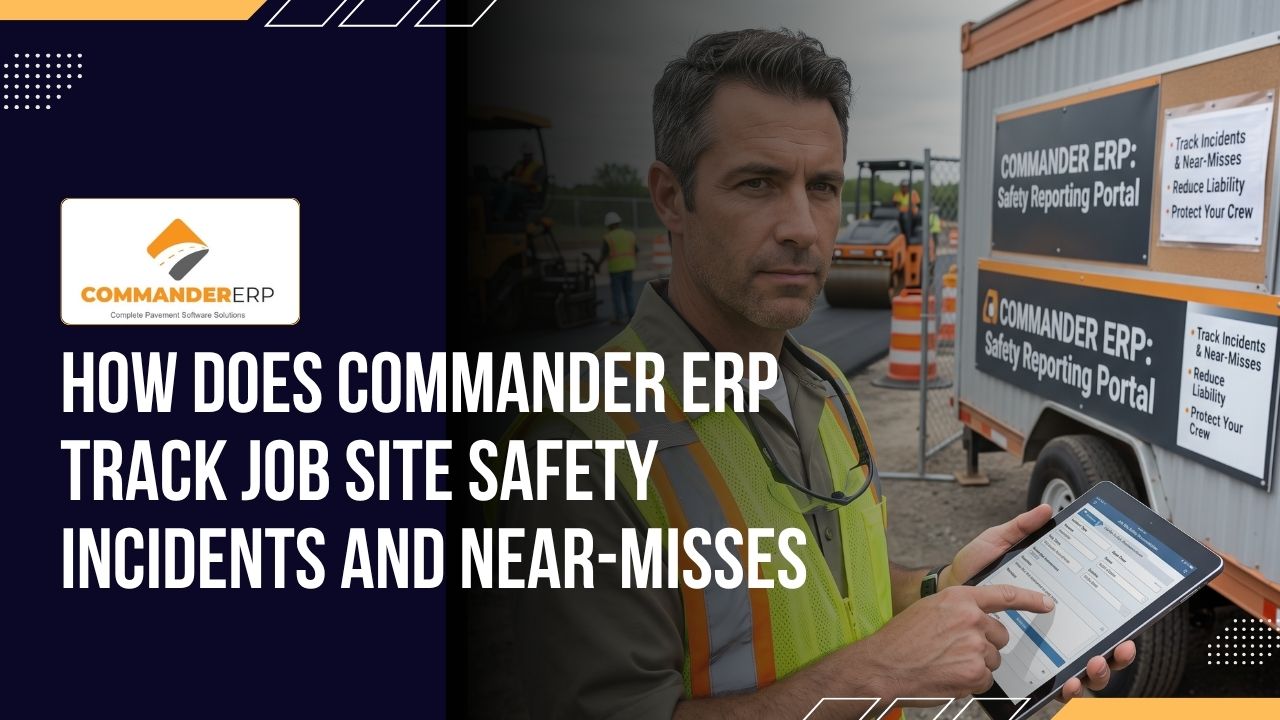
Most paving companies only formally document a safety event after someone gets hurt. The near-misses, the close calls, the moments where a piece of equipment almost struck a worker or a truck almost backed into an active lane, usually go unreported, mentioned only in passing conversation at best. That gap in documentation isn't just a missed opportunity to prevent a future accident, it's a real liability exposure if an incident does eventually occur and there's no record showing the company took safety seriously before that point.
Commander ERP gives paving contractors a structured way to log both incidents and near-misses directly from the field, creating a documented safety record that protects the business and, more importantly, helps prevent the next incident from happening at all.
Why Do Near-Misses Matter as Much as Actual Incidents?
Safety research consistently shows that near-misses are far more common than actual injuries, and that the same underlying hazard that caused a near-miss will often eventually cause a real injury if it isn't addressed. A truck that almost struck a flagger, a roller that nearly tipped on an unstable shoulder, or a worker who almost stepped into an unmarked trench are all warning signs pointing at a hazard that's still present on the job site. Ignoring near-misses because no one was actually hurt means missing the earliest, cheapest opportunity to fix the problem.
How Does Commander ERP Make Incident and Near-Miss Reporting Easier?
Field-Based Reporting from Mobile Devices
Foremen and crew members can log an incident or near-miss directly from a mobile device while still on site, capturing details while they're fresh rather than trying to reconstruct what happened during an end-of-week phone call to the office. This immediacy matters, since details about exactly what happened tend to get lost or distorted the longer they go unrecorded.
Photo and Location Documentation
Reports can include photos of the hazard or the incident scene along with the specific job site location, giving safety managers and, if needed, insurance adjusters or OSHA investigators a clear, contemporaneous record rather than a secondhand description written up days later.
How Does This Data Get Used to Prevent Future Incidents?
Because every report lives in one centralized system rather than scattered across individual foremen's memories or disconnected paperwork, safety managers can look for patterns across jobs, crews, and equipment. If the same type of near-miss keeps showing up on jobs involving a particular piece of equipment or a specific task, that pattern becomes visible and actionable long before it turns into an actual injury.
- Identifying recurring hazards across multiple job sites
- Spotting patterns tied to specific equipment or tasks
- Prioritizing safety training around actual documented risks
- Demonstrating proactive safety management to insurers and clients
How Does Incident Tracking Support OSHA Compliance?
OSHA recordkeeping requirements obligate many employers to document work-related injuries and illnesses in a structured way, and having a digital system that captures incident details, dates, and outcomes makes it significantly easier to produce accurate records if OSHA requests them or during a compliance audit. Beyond formal recordable incidents, having near-miss data available also demonstrates a broader safety culture that can be relevant context during an OSHA inspection following an actual incident.
How Does This Reduce Legal and Insurance Liability?
If a serious incident does eventually happen and the company faces a claim or lawsuit, having a documented history of near-miss reporting and follow-up action is strong evidence that the company took safety seriously and worked to address hazards proactively. The alternative, no records at all, can be used to suggest the opposite, that hazards were known or should have been known and nothing was done about them. Insurance carriers also increasingly favor contractors who can demonstrate active safety monitoring when underwriting policies or evaluating claims.
How Does This Change Safety Culture on the Job Site?
When crew members have an easy, low-friction way to report a near-miss without it feeling like they're getting someone in trouble, reporting tends to increase rather than stay hidden. Over time, that shift builds a safety culture where hazards get flagged and addressed early, rather than one where problems only surface after someone has already been hurt.
Ready to Start Tracking Safety Incidents Before They Become Liabilities?
If your company doesn't currently have a structured way to capture near-misses and incidents from the field, Commander ERP can bring that reporting into the same system you already use for job and crew management. Schedule a demo with the Commander ERP team to see how field-based safety reporting supports compliance, reduces liability, and helps prevent repeat incidents.
Conclusion
A paving company's safety record isn't just about avoiding accidents, it's about having the documentation to show that hazards were identified and addressed before they caused harm. By making it easy to report both incidents and near-misses directly from the field, Commander ERP helps contractors build a safety record that protects the business legally, supports OSHA compliance, and, most importantly, gives crews a real chance to fix a hazard before it hurts someone.
