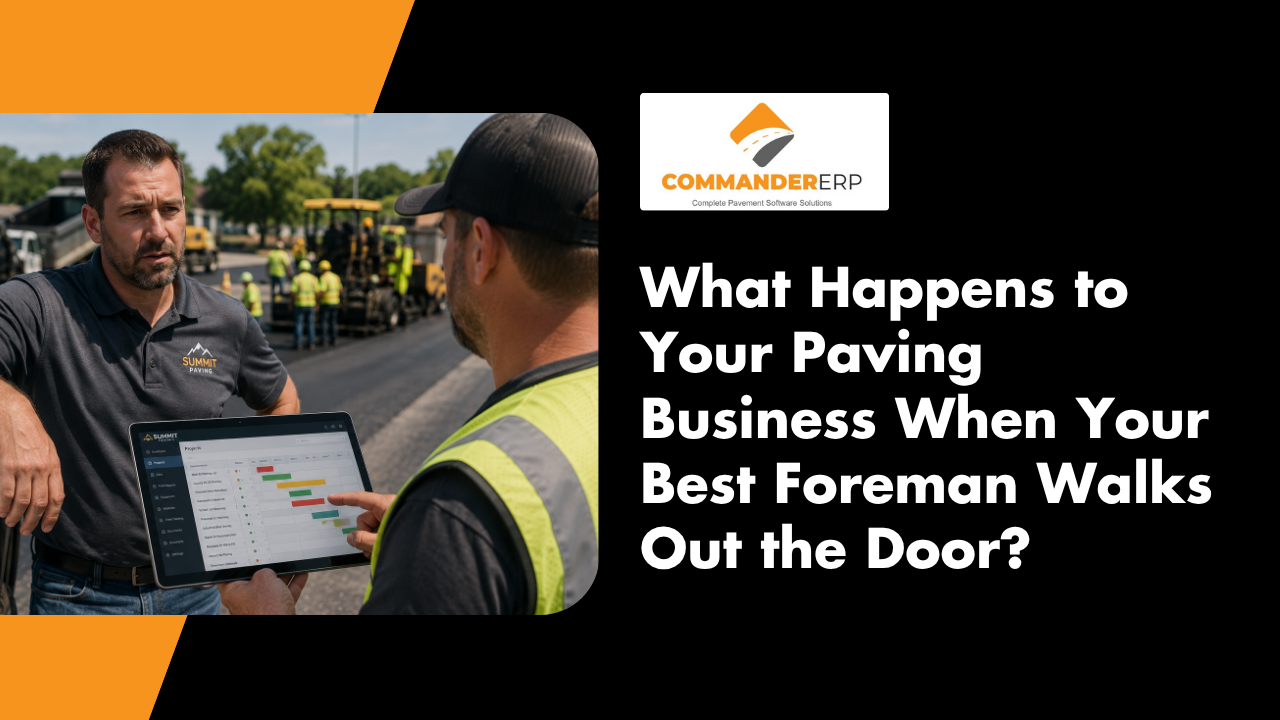
Picture this: It's the middle of your busiest season. You have eleven active jobs, three crews running simultaneously, and equipment out on three different sites. Then your best foreman — the one who knows every job detail, every client preference, every crew quirk — calls to say he's leaving. Gave notice this morning. Last day is Friday.
Your stomach drops. Not because losing him isn't manageable in theory, but because in practice, you realize you have no idea where half the information about his jobs actually lives. It's in his head. In texts on his personal phone. In notes on paper tucked into a binder in his truck.
This is the key employee dependency problem, and it's one of the most dangerous silent risks in a paving business. It doesn't show up on a balance sheet. It doesn't trigger an alert. It just sits there, season after season, until the day that person walks out and suddenly every job they were running is at risk.
The paving contractors who build genuinely resilient businesses don't just hire great foremen. They build systems that make sure the business can run — and run well — regardless of who shows up for work tomorrow.
Why Paving Businesses Are So Vulnerable to Key Employee Departure
The construction industry as a whole struggles with workforce stability. Turnover is consistently among the highest of any industry sector, and the departure of a skilled foreman or crew lead can easily cost a paving company between $21,000 and $35,000 in direct and indirect losses — before factoring in project disruption, client friction, or quality issues on active jobs.
But the financial cost of replacing someone is only part of the problem. The deeper issue is institutional knowledge — the operational information, job history, client relationships, and daily decision-making that exist only in one person's head, with no documented record anywhere in the business.
The Knowledge That Walks Out With Your Foreman
When a top foreman leaves a paving company that runs on informal systems, they take with them:
- The status of every active job they were managing — where it stands, what's left, what the client expects
- Informal agreements and understandings made in the field that were never documented
- Material ordering patterns, supplier preferences, and vendor relationships built over years
- Crew management knowledge — who works well together, who needs supervision, who can be trusted on complex tasks
- Client communication history — complaints, preferences, relationship nuances that affect how the account should be handled
- Site-specific details — subgrade conditions, access issues, equipment restrictions, and job-specific quirks
None of this is malicious. The foreman isn't hoarding information. It just naturally accumulates in the person doing the work, because there was never a system that required it to live anywhere else.
What "Business Disruption" Actually Looks Like on the Ground
When that person leaves mid-season, here's what happens in practice:
- A crew shows up to a job and isn't sure which section they're supposed to be working on that day
- A client calls the office with a question and nobody can give them a confident answer
- An equipment delivery arrives at a site with a specific access restriction nobody in the office knew about
- A material order gets duplicated because the new crew lead doesn't know what was already ordered
Each of these is a small operational failure. Together across two or three active jobs, they add up to delays, rework, client frustration, and margin erosion — all happening simultaneously, at the worst possible time of year.
The Real Risk Isn't Turnover — It's Over-Dependency
Every paving business will experience employee turnover. Foremen move on. Crew leads get better offers. Experienced operators retire. That's the reality of any labor-intensive industry. The risk isn't that people will leave — they will. The risk is that you've built a business that cannot function when they do.
Over-dependency on key individuals is a structural problem, not a personnel problem. It means the business's operational intelligence lives in people instead of systems. And the only way to fix it is to move that intelligence into a platform that's accessible to everyone who needs it, regardless of who's on the crew that day.
Signs Your Paving Business Is Over-Dependent on Key People
- You have one or two foremen who "just know" how things work, and you'd struggle to explain their jobs to a replacement
- Job status updates exist primarily in text messages between your foreman and the office
- When someone calls in sick or quits, there's a scramble to figure out what they were doing and where things stand
- New crew members take weeks to get up to speed because there's no documented process to follow
- Client-specific preferences, site details, and project history live with individual employees rather than in a shared system
- When you're not personally on site, you're not confident things are being handled consistently
If more than two or three of these sound familiar, your business has a key person dependency problem — and the next departure is going to hurt.
What Crew-Independent Operations Actually Look Like
A crew-independent paving operation isn't one where people don't matter or great foremen aren't valued. It's one where the systems are strong enough that a new person can step into any role and quickly understand what's happening, what needs to happen next, and how to do their job correctly — without requiring weeks of shadowing or institutional knowledge transfer.
In a crew-independent paving business, the answer to "what's happening on Job 14 right now?" isn't "ask Marcus." It's "log into the system."
Job Information Lives in the Platform, Not in People
Every active job has a complete, up-to-date digital record — scope of work, current status, materials ordered, crew assigned, hours logged, client notes, and outstanding tasks. When a crew lead opens the job on Commander ERP from their mobile device, they see exactly where things stand. When the office needs to answer a client question, they open the same record. There's no need to call the foreman. There's no guesswork.
Crew Assignment and Scheduling Is System-Managed
In Commander ERP, crew scheduling isn't managed through text messages or whiteboard assignments that disappear when the whiteboard gets erased. Every crew member is assigned to specific jobs through the platform. Shift coverage is visible across the whole organization. When someone calls out, the system shows who's available and what jobs they're qualified to cover. A replacement isn't starting from scratch — they're stepping into a documented role with clear expectations already in the system.
Client Communication Has a Documented History
When your foreman leaves, do you know what was promised to the clients on their jobs? What commitments were made about timing, deliverables, and quality expectations? In Commander ERP, client interactions and job notes are logged in the system — not in personal phones. When a new crew lead or project manager picks up a job, they have the full history in front of them. They can call the client and speak intelligently about their project without needing to ask the person who just quit.
Standard Processes Replace Tribal Knowledge
One of the most powerful benefits of building operations in an ERP system is that it forces standardization. When your workflow for starting a job, logging daily progress, ordering materials, and closing a project all happens inside Commander ERP, that workflow becomes the standard — not the foreman's personal process. A new hire follows the same steps. An experienced crew lead follows the same steps. The system holds the process, so you're not dependent on any one person to carry it.
How Commander ERP Specifically Protects Your Business from Key Person Risk
Commander ERP was designed for paving and construction operations where the work happens in the field, decisions happen quickly, and the gap between what the field knows and what the office knows is where most business risk accumulates.
Mobile-First Field Documentation That Captures Everything in Real Time
Every job update, material usage log, labor entry, inspection note, and status change made in the field goes directly into the job record in Commander ERP — from a mobile device, in real time. The foreman doesn't send a recap at the end of the day. The information lives in the system the moment it's created. If that foreman is gone tomorrow, everything they entered is still there, accessible to whoever picks up the job.
Role-Based Dashboards That Show Every Employee What They Need
Commander ERP's employee dashboards give each team member a clear view of their assigned jobs, today's priorities, and outstanding tasks — without requiring them to ask a supervisor. A crew member logging in for their first day on a job can see the full picture of what's been done, what's left, and what their specific responsibilities are. This isn't just good for turnover situations — it's a daily operational advantage that reduces the management burden on every foreman, senior or junior.
Pre-Trip Inspections and Equipment Logs That Belong to the Business
Equipment knowledge is another area where paving businesses are often dangerously dependent on specific operators. Commander ERP captures daily pre-trip inspections, equipment notes, and maintenance history in the job record — so that knowledge belongs to the business, not to one person's memory.
Time Log History That Survives Personnel Changes
When a crew lead leaves, their time logs, job entries, and historical records remain in Commander ERP. Nothing disappears. New supervisors can review what was logged on any job, during any period, by any employee. This protects you in disputes, supports accurate job costing, and gives replacement personnel the context they need to step into an active job without being completely blind to its history.
Centralized Communication Between Field and Office
Commander ERP replaces the informal, fragmented communication channels — personal text messages, phone calls, verbal updates — that make paving businesses so vulnerable when key people leave. Job-related communication happens inside the platform, attached to the job record, visible to everyone with appropriate access. Nothing lives in a personal inbox. Nothing is lost when a phone number leaves the company.
Building a Business That Can Run Without You (Or Anyone Else)
The goal of crew-independent operations isn't just to survive employee turnover — it's to build a business that's genuinely scalable. A paving company that depends on two or three key people can only grow as fast as those people can manage. When you remove that dependency, you remove the ceiling.
New Hires Onboard Faster With System-Guided Processes
When your operations live in Commander ERP, onboarding a new foreman or crew lead isn't a months-long knowledge transfer. They follow the process the system defines. They review the job records the system maintains. They communicate through the platform the rest of the team uses. They're productive faster — which means less downtime, less scrambling, and less cost associated with every personnel transition.
Multiple Crews Scale Without Proportional Management Overhead
As you grow from one crew to three or five, the management complexity grows exponentially if your operations are people-dependent. Every new crew is another set of foremen to depend on, another layer of informal processes to manage. With Commander ERP, each new crew operates within the same system, following the same documented processes, with the same visibility from the office. Growth adds capacity without proportionally adding risk.
Owner Visibility That Doesn't Require Being on Every Job Site
For many paving business owners, the hardest part of growth is letting go of personal oversight — because their systems don't give them confidence that things are being handled correctly when they're not there. Commander ERP gives owners real-time visibility into every active job, every crew's status, every cost trend, and every outstanding issue — from anywhere. You're not dependent on a daily call with your foreman to know what's happening. The system tells you.
Frequently Asked Questions
How much does it cost a paving business when a key foreman leaves?
The direct costs of replacing a mid-level foreman — recruiting, onboarding, training, and productivity gap — can run between $21,000 and $35,000. Add to that the indirect costs of project disruption, client friction, and margin erosion on active jobs, and a single departure during peak season can easily cost a paving company $40,000 to $60,000 in total impact.
What is "institutional knowledge" and why is it a risk for paving contractors?
Institutional knowledge is the operational information, job history, client relationships, and decision-making experience that an employee carries in their head. In paving companies that run on informal systems, this knowledge often lives only with key individuals — foremen, senior operators, experienced estimators. When those people leave, the knowledge leaves with them, leaving gaps in active jobs, client relationships, and operational continuity.
How does Commander ERP reduce dependency on individual employees?
Commander ERP requires job information, crew assignments, client communications, material logs, and work history to be captured in the platform — not in personal phones or paper notes. This means any qualified employee can step into any role and access the complete operational picture of any job. The business's knowledge lives in the system, not in any one person.
Can Commander ERP help with onboarding new crew members faster?
Yes. When your operations run inside Commander ERP, new crew members and foremen can review job records, prior entries, client notes, and status updates from their first day. The system-guided workflow defines the process, so new hires aren't dependent on shadowing experienced employees for weeks. This significantly reduces the time and cost associated with getting new personnel productive on active jobs.
Does Commander ERP work for small paving companies or just large operations?
Commander ERP is built to scale with paving businesses at different stages. For smaller operations, it provides the same structured workflow and documentation that larger companies rely on — reducing dependency on key individuals and creating a foundation for growth. In fact, smaller companies often benefit most from the structure, because they have the least redundancy to absorb the impact of a key employee leaving.
How long does it take to implement Commander ERP and train a paving crew?
Commander ERP is designed for field crews, not IT departments. Mobile-first interfaces mean crew members can learn the core functions quickly. Most paving companies are operational on the platform within 30 days, with the training burden distributed across the team rather than concentrated on any single person — which itself models the kind of crew-independent operation the platform is built to support.
Your Business Shouldn't Have a Single Point of Failure
A paving company with one irreplaceable foreman isn't a staffed business — it's a fragile one. The work looks the same from the outside. The trucks are running, the asphalt is going down, the jobs are getting done. But underneath, there's a structural vulnerability that becomes a crisis the moment that person decides to leave.
Building crew-independent operations isn't about replacing the value of experienced people. It's about making sure the business captures what those people know — and that the knowledge stays in the system even when the person doesn't.
Commander ERP gives your paving business the structure to run consistently, professionally, and profitably — regardless of who shows up for work tomorrow.
Ready to build a business that doesn't break when key people leave?
See how paving contractors are building crew-independent operations that scale.
Book a Free Demo with Commander ERP