2026-08-27

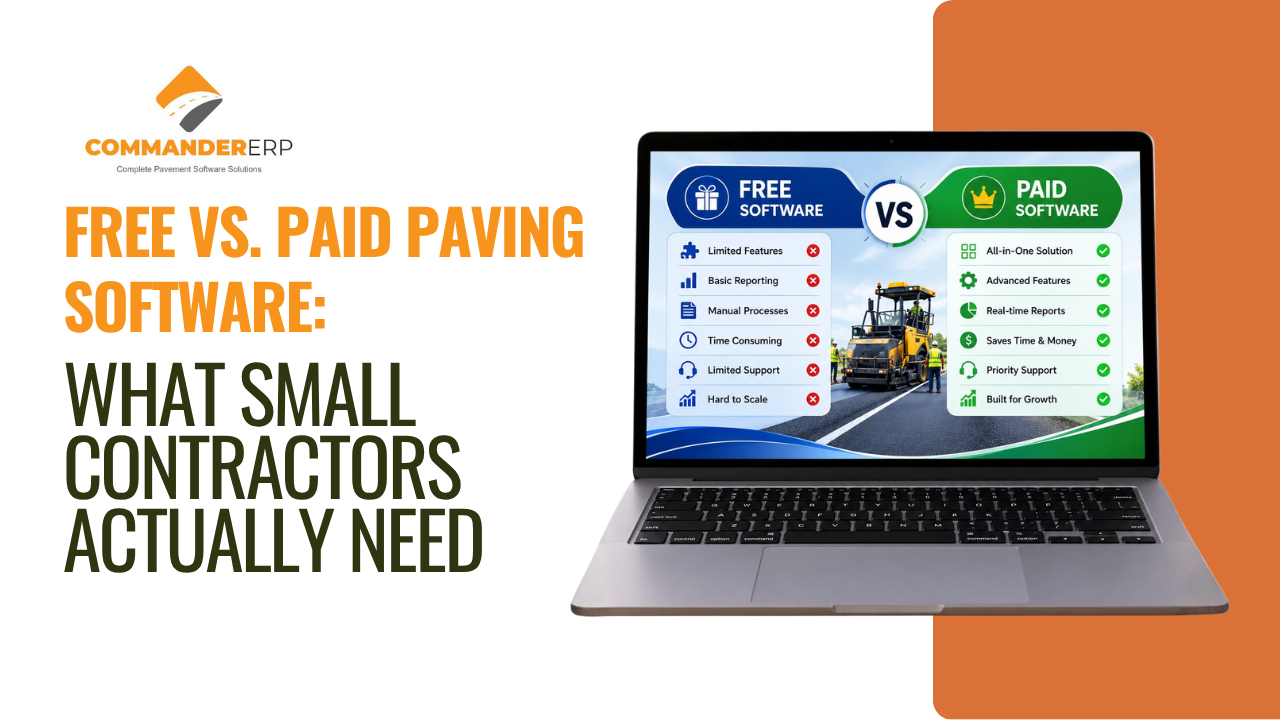
Every small paving contractor starts somewhere close to free: a spreadsheet for estimates, a free invoicing app, a group text for scheduling. It works fine — until it doesn't. The question isn't whether free tools have a place. It's knowing exactly where that place ends and paid software starts earning its cost back.
Free tools aren't a myth or a compromise — several are genuinely solid for a specific job. Free-tier estimating tools can handle basic material takeoffs and cut/fill calculations. Free document tools cover simple contracts and e-signatures. For a solo operator bidding the occasional job, these can be perfectly adequate starting points.
| Capability | Free Tools | Paid / Integrated Software |
|---|---|---|
| Estimating | Basic calculators, manual entry | Automated takeoffs tied to real cost data |
| Job Costing | Rarely included | Built in, tracked by job and crew |
| Scheduling & CRM | Separate free apps, disconnected | Connected to estimating and job data |
| Support | Community forums or none | Dedicated onboarding and support |
| Best Fit | Solo operators, occasional bids | Companies running multiple crews or jobs |
The gap shows up in three places most often:
Free feels free until you count what it costs in time. Industry research on paving contractors found that companies juggling four to six disconnected free and low-cost tools — separate apps for CRM, invoicing, scheduling, and estimating — typically spend $150 to $300 a month total and lose six to ten hours a week to administrative work an integrated platform would handle automatically.
That's not a software cost. It's an owner or office manager's time, every single week, spent re-entering the same information into three different places.
Paid, integrated software earns its cost back once your business hits a certain level of complexity — not a certain size. You've likely crossed that line if:
At that point, the hours saved by having estimating, scheduling, and job costing talk to each other usually outweigh the subscription cost within the first season.
If you're a solo operator or two-person crew handling occasional jobs, free tools can carry you further than you might expect — there's no need to overbuy. But if administrative work is eating into hours you'd rather spend bidding or running crews, that's usually the clearest sign it's time to consolidate into paid, connected software built for the trade.
Commander ERP combines estimating, scheduling, job costing, and CRM in one platform built for paving and asphalt contractors. Book a free demo and see how much admin time you could get back.
Book a Demo