2026-08-27

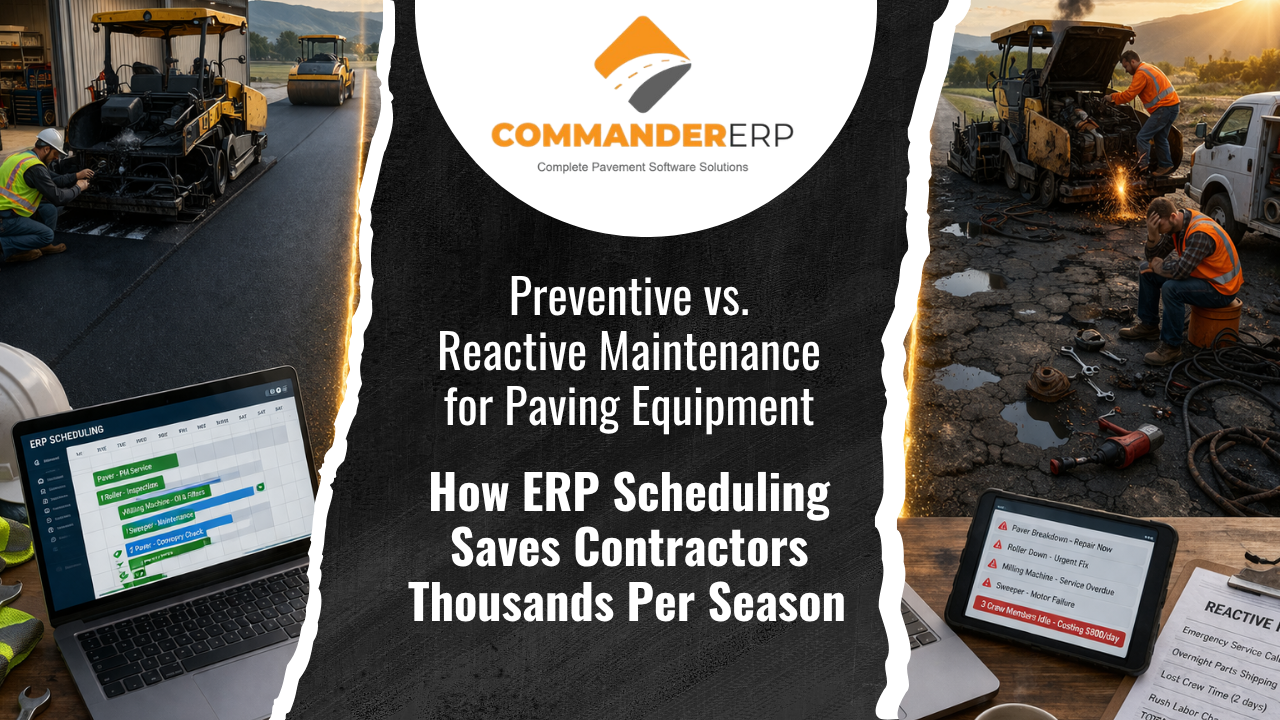
It's 6:45 AM on a Tuesday in mid-July — your busiest paving week of the season. The crew is loaded and ready to roll, the asphalt plant has confirmed the first load, and the client has a hard deadline for lane reopening. Then the paver won't start. Hydraulic warning light. Something in the pump system. The mechanic won't be there until noon.
Every paving contractor who has run a fleet for more than two seasons has a version of this story. The names and machines change — but the outcome is always the same. A job delayed. A crew standing down on the clock. An emergency repair bill two to three times what scheduled maintenance would have cost. And a client call that starts with an apology.
Reactive maintenance — fixing equipment after it breaks — is not a strategy. It's a symptom of a business that hasn't yet built a system for managing its most expensive assets. Preventive maintenance, powered by ERP scheduling, is how the most profitable paving contractors in North America keep their fleets running, their jobs on schedule, and their margins intact.
This article shows you exactly what preventive maintenance looks like in practice, what reactive maintenance is actually costing your business beyond the repair bill, and how Commander ERP's equipment scheduling and alert system transforms how you protect and manage your paving fleet.
When a paving contractor runs the numbers on a bad season, equipment failures rarely appear as a single line item. Instead, their cost spreads across multiple budget categories — the repair invoice goes to equipment, the idle crew hours go to labor, the delayed job penalty goes to client relations, and the missed deadline goes nowhere because nobody tracks reputation damage on a spreadsheet.
This is what makes reactive maintenance so dangerous for paving companies: its true cost is always larger than it appears, and most of it is invisible until you go looking for it.
Preventive maintenance eliminates most of these costs entirely. The ones it doesn't eliminate — like the cost of the service itself — it makes predictable, schedulable, and dramatically cheaper than emergency alternatives.
Equipment replacement costs are further compounded by current tariff pricing on paving machinery — making prevention even more financially critical.
Here is what the preventive versus reactive maintenance decision looks like across the most common paving equipment failure types — with real cost ranges based on industry service data:
| Failure Type | Reactive Cost | Preventive Cost | Saving Per Incident | Hidden Impact |
|---|---|---|---|---|
| Unplanned Paver Breakdown | $4,200–$8,500 | $320–$680 | $3,880–$7,820 | Job delay, crew standdown, client claim risk |
| Hydraulic Failure on Roller | $2,800–$5,200 | $180–$320 | $2,620–$4,880 | Compaction quality issue — potential rework |
| Truck Engine Failure | $6,500–$14,000 | $420–$750 | $6,080–$13,250 | Material delivery stopped, multiple jobs affected |
| Milling Head Replacement | $8,000–$22,000 | $600–$1,100 | $7,400–$20,900 | Project scope reduction, schedule overrun |
| Sealcoat Pump Failure | $1,200–$3,400 | $90–$180 | $1,110–$3,220 | Job rescheduled, client rebooking cost |
These figures represent direct repair costs only. When you add the indirect costs — idle crew, delayed jobs, emergency logistics, and client management — the gap between preventive and reactive total cost routinely exceeds $10,000 per incident for major equipment failures during peak season.
Now multiply that by the number of avoidable breakdowns a fleet of six to ten machines experiences across a full season — and the annual cost of running a reactive maintenance operation becomes one of the largest single drains on paving company profitability.
Learn more about asphalt paving .
Preventive maintenance for paving equipment follows a tiered structure — daily checks, weekly service intervals, mid-season overhauls, and annual full inspections. Here is the recommended schedule for the most common paving and asphalt equipment types:
| Equipment Type | Pre-Trip Check | Service Interval | Mid-Season Service | Annual Overhaul |
|---|---|---|---|---|
| Asphalt Paver | Daily | Weekly | Every 250 hrs | Every 500 hrs |
| Roller / Compactor | Daily | Weekly | Every 250 hrs | Every 500 hrs |
| Milling Machine | Daily | Weekly | Every 200 hrs | Every 400 hrs |
| Dump Truck / Haul Truck | Daily | Weekly | Every 5,000 mi | Every 15,000 mi |
| Skid Steer / Loader | Daily | Weekly | Every 250 hrs | Every 500 hrs |
| Crack Fill Equipment | Per Use | Monthly | Seasonally | Annually |
| Sealcoat Sprayer | Per Use | Monthly | Seasonally | Annually |
| Line Striper | Per Use | Monthly | Seasonally | Annually |
Managing this schedule manually — across a fleet of eight to fifteen machines, each with its own service history and upcoming milestones — is where most paving companies fail. The service logs exist on paper or in someone's head. The alerts don't exist at all. And the first reminder that a machine is overdue is the breakdown itself.
Commander ERP Tip
Load every piece of equipment into Commander ERP with its current hour reading, last service date, and manufacturer service interval on Day 1 of your onboarding. The system calculates every upcoming service milestone automatically from that point forward — and sends alerts before they're due, not after.
Commander ERP's equipment and fleet management module is purpose-built for paving and construction contractors. It doesn't just track maintenance — it actively prevents breakdowns by managing every service milestone, alert, and cost allocation automatically across your entire fleet.
Every piece of equipment in Commander ERP has a maintenance profile: service type, interval (hours or calendar-based), last completed date, and next due date. As equipment accumulates hours through job assignments, the system automatically calculates when each service milestone is approaching.
Alerts are sent to the designated manager before the service is due — not when it's already overdue. You choose the lead time: 10 hours before a service interval triggers, or 2 weeks before a calendar-based inspection. The goal is to schedule maintenance during downtime windows, not scramble to fit it around live jobs.
Commander ERP's pre-trip inspection workflow feeds directly into the equipment maintenance system. When a foreman or operator completes a daily pre-trip check on the mobile app and flags a potential issue — an unusual vibration, a warning light, a fluid level concern — that flag is logged against the equipment record and triggers a review task for the shop manager.
This creates a direct feedback loop between field operators and the maintenance team, turning every crew member into an early warning system for equipment issues before they become costly failures.
Daily pre-trip inspections are the first line of preventive maintenance — ERP scheduling is the system that acts on what those inspections find.
One of the most powerful — and most overlooked — features of ERP-based maintenance management is equipment cost allocation. Every maintenance service, repair, and fuel fill-up logged in Commander ERP is assigned to a specific machine. That machine's running cost is then allocated across the jobs it works on, giving you true job profitability rather than a figure that ignores the real cost of running your fleet.
When you know that your oldest paver costs $38 per hour to operate versus $22 for your newer machine, you can price jobs accordingly, prioritise replacements intelligently, and build accurate bids that reflect actual fleet costs — not theoretical depreciation.
Preventive maintenance is only as effective as your parts supply chain. Commander ERP's inventory module tracks the spare parts and consumables your maintenance schedule requires — filters, belts, hydraulic fluid, wear components — and generates reorder alerts when stock falls below your set minimum.
This means the parts needed for next week's scheduled service are on the shelf before the service is due — not emergency-ordered the day the machine goes down. It's a small operational change with a significant impact on maintenance cost and turnaround time.
Every service, repair, inspection, and pre-trip flag logged in Commander ERP is stored permanently against the equipment record. This creates a complete, searchable maintenance history for every machine — from the day it was added to the fleet through to the day it's sold or retired.
This history has direct financial value. When you sell equipment, a documented maintenance log increases resale value. When you're audited for insurance or compliance, the records are immediately accessible. When you're evaluating whether to repair or replace a machine, the full cost-per-hour history makes the decision data-driven rather than instinctive.
Not sure whether your current maintenance approach is costing you more than you realise? These five warning signs indicate a reactive maintenance culture — and a significant opportunity to recover margin through ERP-driven prevention:
If three or more of these apply to your operation, the annual cost of your reactive maintenance approach is almost certainly higher than the annual cost of a Commander ERP subscription — often within the first season alone.
Use this checklist to set up and maintain a fully preventive equipment maintenance system inside Commander ERP:
CKC Operations described their experience with Commander ERP's equipment management: the platform connects every department — field crews, office staff, and shop teams — in real time. Equipment status, maintenance flags, and upcoming service milestones are visible to everyone who needs them, eliminating the communication breakdowns that allow small issues to become expensive failures.
Every paving contractor knows that equipment is the backbone of the business. Pavers, rollers, trucks, and millers don't just enable the work — they determine whether that work is delivered on time, on budget, and at the quality level that wins repeat clients and referrals.
Reactive maintenance treats that backbone as something to fix when it breaks. Preventive maintenance — managed through Commander ERP's scheduling, alert, and cost allocation system — treats it as the asset it is: something worth protecting, tracking, and optimising for maximum return across every season.
The cost of a scheduled service is known, plannable, and small. The cost of an unplanned breakdown during peak season is unpredictable, compounding, and far larger than it appears on the repair invoice. The choice between the two is not a maintenance decision — it's a profitability decision.
Commander ERP automatically schedules equipment maintenance, sends alerts before service is due, tracks every repair log, and links equipment costs to the jobs they serve — giving paving contractors complete visibility and control over their most expensive assets.
Book Your Free Demo+1-435-823-2632 | info@commandererp.com