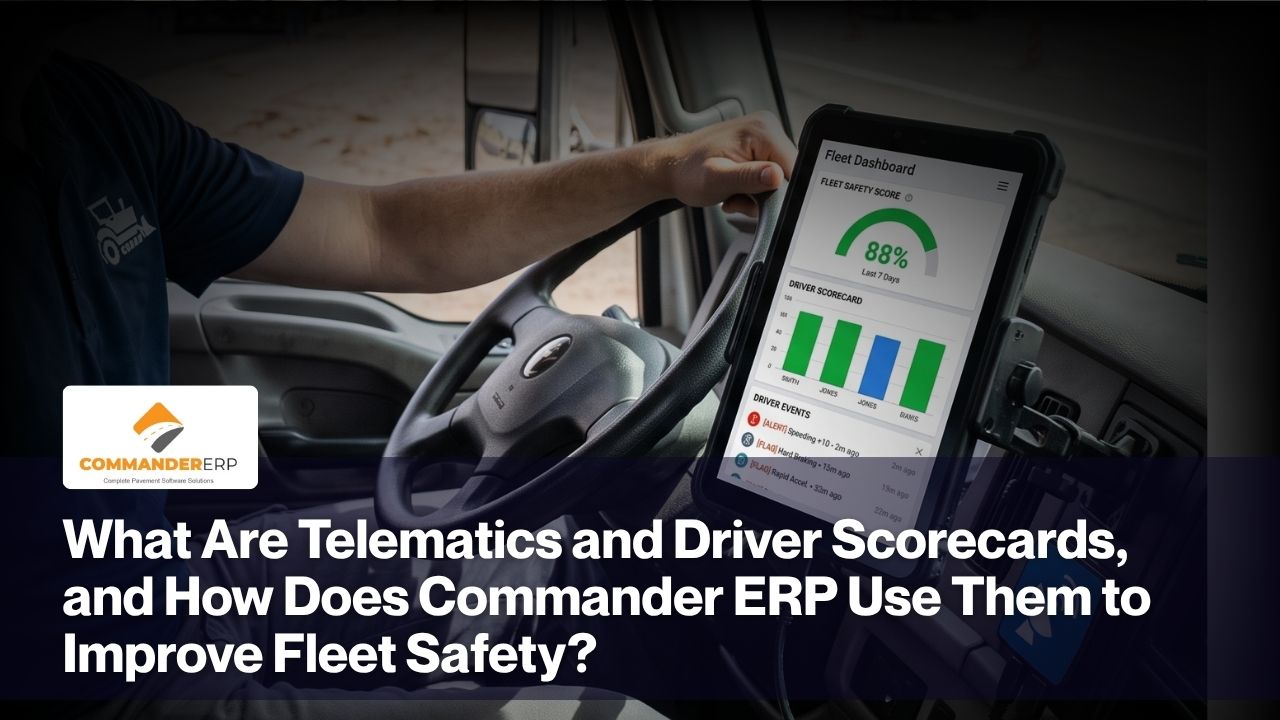
Paving companies run heavy trucks, rollers, and equipment haulers on public roads every day, often driven by operators under pressure to hit a tight schedule between job sites. That combination of heavy machinery, tight timelines, and constant road exposure means fleet safety isn't optional, it's directly tied to insurance costs, liability exposure, and how long your equipment actually lasts. Telematics and driver scorecards give paving companies a way to see what's actually happening behind the wheel, instead of only finding out after an accident, a near-miss, or a spike in the insurance renewal.
Here's what telematics and driver scorecards actually are, and how Commander ERP uses that data to help paving contractors build a safer, more accountable fleet.
What Is Telematics, Exactly?
Telematics refers to data collected from a vehicle or piece of equipment using GPS and onboard sensors, then transmitted back to a central system for review. In a fleet context, that typically includes location, speed, harsh braking or acceleration events, idle time, and sometimes engine diagnostics. Instead of relying on a driver's own account of a trip or an accident, telematics gives an objective, timestamped record of what the vehicle actually did.
What Is a Driver Scorecard?
A driver scorecard takes raw telematics data and turns it into a simple, comparable rating for each driver, based on factors like speeding events, hard braking, rapid acceleration, and seatbelt use where available. Rather than a fleet manager trying to manually review GPS logs for every truck, a scorecard surfaces which drivers are operating safely and which ones may need coaching, in a format that's easy to review at a glance.
How Does Commander ERP Use Telematics and Scorecards Together?
Centralized Fleet Visibility
Commander ERP brings telematics data into the same system where you're already managing jobs, crews, and equipment, so fleet safety data isn't siloed in a separate app that nobody checks regularly. Fleet managers can see vehicle activity alongside job assignments, giving context to patterns like consistent speeding on a particular route or excessive idling at a specific job site.
Automated Driver Scoring
Rather than manually compiling scorecards, Commander ERP can generate them automatically from the underlying telematics data, giving fleet managers a consistent, ongoing view of driver behavior over time rather than a one-time snapshot.
Trend Tracking Over Time
A single hard-braking event doesn't necessarily mean much on its own, but a pattern of repeated hard-braking events from the same driver over several weeks is worth addressing before it turns into an accident. Commander ERP's ongoing tracking makes those patterns visible instead of letting them go unnoticed in scattered, one-off telematics alerts.
How Does This Reduce Insurance Costs and Liability?
Insurance carriers increasingly look favorably on fleets that can demonstrate active safety monitoring and driver accountability programs, and some offer reduced premiums to companies that use telematics-based safety programs. Beyond the premium itself, having documented driver behavior data can also be critical in the event of an accident claim or lawsuit, giving your company objective evidence of driving conduct rather than relying on conflicting eyewitness accounts.
- Potential premium reductions for demonstrated safety monitoring
- Objective evidence in the event of an accident or liability claim
- Early identification of risky driving patterns before an incident occurs
- Documentation supporting a proactive safety culture during audits
How Does This Help Extend the Life of Fleet Equipment?
Harsh braking, rapid acceleration, and excessive idling don't just increase accident risk, they also accelerate wear on brakes, tires, and engines. By identifying and coaching drivers who consistently operate more aggressively than necessary, paving companies can reduce unnecessary wear across the fleet, extending the useful life of trucks and equipment haulers that represent a significant capital investment.
How Does This Support Coaching Instead of Just Punishment?
Driver scorecards work best when they're used as a coaching tool rather than purely a disciplinary one. Fleet managers can use scorecard trends to have specific, data-backed conversations with drivers about particular habits, rather than vague warnings, which tends to produce better long-term behavior change than punitive action alone.
Ready to Get Real Visibility Into Your Fleet's Safety Performance?
If your company doesn't currently have a way to objectively track driving behavior across your fleet, Commander ERP can bring telematics data and automated driver scorecards into the same system you already use for job and crew management. Schedule a demo with the Commander ERP team to see how fleet safety data connects to the rest of your operations.
Conclusion
Fleet safety isn't something paving companies can manage effectively by waiting for something to go wrong. Telematics and driver scorecards give fleet managers the objective, ongoing visibility needed to catch risky driving patterns early, support insurance and liability positioning, and extend the life of expensive equipment. When that data lives inside Commander ERP alongside job and crew information, it becomes part of how the business runs day to day, not just a report nobody looks at until after an accident.
