2026-08-27

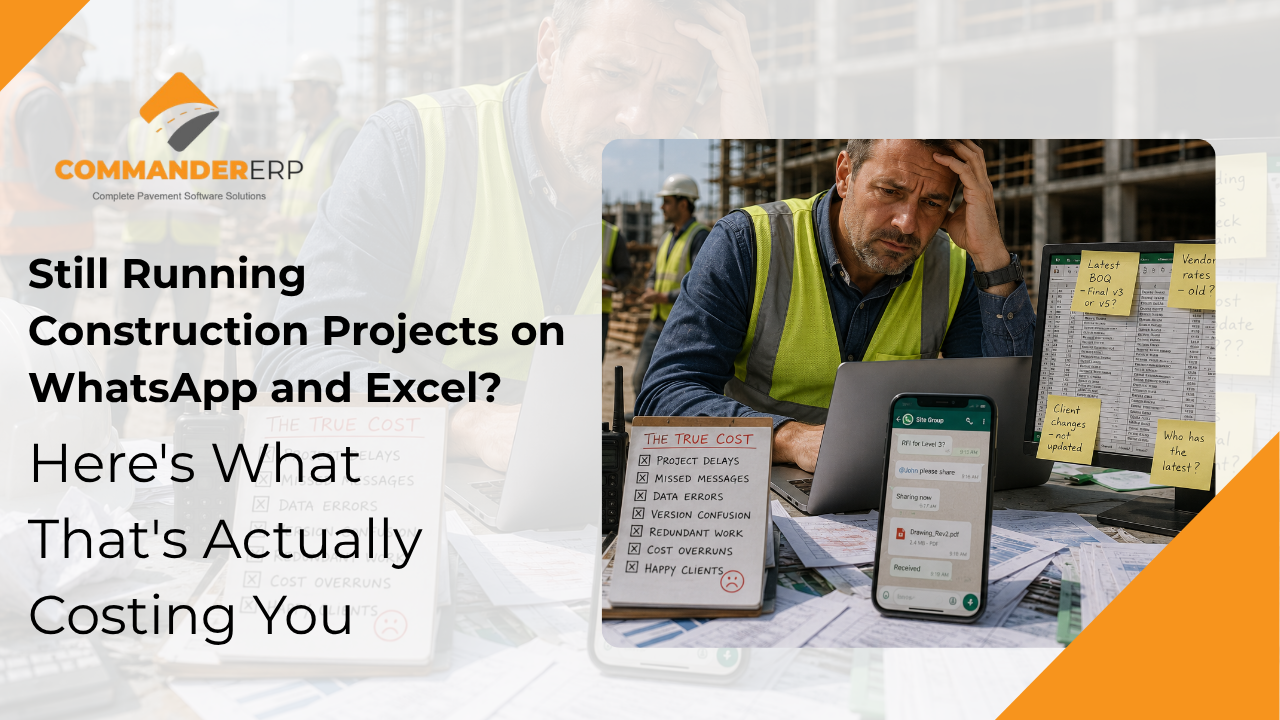
Let's be honest. If you run a construction business in India today, there's a high probability your daily operations look something like this: project updates in a WhatsApp group, budgets in Excel, attendance in a register, purchase orders by phone call, and progress reports assembled from photos sent to the director's personal phone.
It works. Until it doesn't.
This article isn't here to criticise the tools that got your business to where it is. WhatsApp and Excel are genuinely useful. But at a certain scale of operations, their limitations stop being inconveniences and start becoming business risks. This article quantifies what those risks actually cost — and what the transition to a cloud ERP looks like in practice.
The adoption of informal tools in Indian construction is completely rational. WhatsApp is free, everyone has it, and it works immediately. Excel is flexible, familiar, and doesn't require a vendor relationship. For a small contractor managing one or two projects, this setup is genuinely sufficient.
The problem is that most construction businesses never consciously decided to 'upgrade their systems.' They just kept adding people to the WhatsApp group and adding tabs to the Excel file — until the group has 47 members and no one knows which version of the budget is current.
Excel files are manual. People update their own version. Someone shares an old file by mistake. Decisions get made on outdated data. On a construction project where a single day of labour costs INR 2–5 lakh, a decision made on week-old data can result in immediate, irreversible losses.
A conservative estimate: construction businesses running on manual tools make at least 3–5 significant decisions per month based on data that is either incorrect or out of date. Even if each mistake costs only INR 1 lakh — that is INR 12–60 lakh per year in avoidable losses.
Critical project information buried in a WhatsApp conversation is effectively lost. When a new site manager joins mid-project, there is no way to search through 10,000 messages to reconstruct what was decided, when, and by whom. When a subcontractor disputes a claim, the evidence is scattered across group chats.
WhatsApp has no audit trail, no access controls, no structured data, and no accountability. It is a communication tool being used as a project management system — and it fails at that purpose.
In most construction businesses using informal tools, there is one person — usually the MD or a senior director — who serves as the human integration layer between all the WhatsApp groups and Excel files. They alone have the full picture, because they are part of every conversation and have access to every file.
This is both a business continuity risk and an opportunity cost. A director spending 3–4 hours daily managing information flow is a director not spending that time winning new business, managing client relationships, or making strategic decisions.
In a WhatsApp-and-Excel operation, project progress claims require manual compilation. Someone must collect data from multiple sources, verify it, format it, and submit it to the client. This process takes time — often 1–2 weeks from when the work is actually done to when the invoice is raised.
For a construction business with INR 10 crore in annual revenue, a consistent 2-week billing lag means approximately INR 38 lakh is permanently outstanding at any given time. At a borrowing cost of 12% per annum, that's INR 4.6 lakh per year in unnecessary interest cost — simply from delayed billing.
When commitments are made verbally or via WhatsApp message, disputes are inevitable. 'You said 15 days.' 'No, I said 20.' Without a formal record, the resolution defaults to whoever negotiates harder — which is rarely the outcome you want.
The common objection to ERP adoption is complexity — the assumption that moving from WhatsApp and Excel to a proper system requires months of implementation, expensive consultants, and significant business disruption. This is no longer true for modern cloud ERP platforms.
| Activity | WhatsApp + Excel | Commander ERP |
|---|---|---|
| Daily site progress update | Photos to WhatsApp group, director reviews | Foreman logs update on mobile app in 5 minutes |
| Raising a purchase order | Phone call, WhatsApp message, hope for the best | Digital PO raised, routed for approval, tracked to delivery |
| Checking project budget status | Open multiple Excel files, reconcile manually | Live dashboard: budget vs. actual in one click |
| Labour attendance | Paper register, manual entry into payroll spreadsheet | Digital attendance directly linked to payroll and cost codes |
| Billing a client | Compile data manually, takes 1–2 weeks | Progress claim generated from live project data in hours |
| Finding a past decision | Search WhatsApp history, ask the person who was there | Audit trail with timestamps, searchable in seconds |
Switching to ERP does not mean reinventing your business. Your processes, your relationships, your site culture — these remain unchanged. What changes is the tool that records and connects the information those processes generate.
Your foreman still does the same daily walkthrough. They just log it in the app instead of sending a WhatsApp message. Your procurement team still calls suppliers. They just raise a formal PO in the system first.
The biggest implementation risk for construction businesses is not technical — it's behavioural. The hardest part of moving away from WhatsApp is that people will still try to use it out of habit. Successful ERP adoption requires visible leadership commitment: senior team members using the system consistently, and expectations set clearly from the start.
The answer is almost always: sooner than feels comfortable. Construction businesses tend to recognise the need for ERP only after they have suffered a painful consequence of not having it — a major cost overrun, a client dispute, a billing audit that exposed their data gaps.
The businesses that make the move proactively — before the crisis — are the ones that gain competitive advantage. They bid with more confidence, they execute with more precision, and they grow faster because their systems can support growth without proportional increases in headcount.
WhatsApp and Excel are not enemies of good construction management. They are tools that have been asked to do a job they were never designed to do. When your business reaches the point where coordination, financial visibility, and accountability matter — and in construction, that point comes quickly — it's time for a tool built for the purpose.
Commander ERP is that tool. Built for Indian construction businesses, designed for the real operational environment your team works in every day, and accessible on the devices your team already uses. The transition from informal tools to professional ERP is not as difficult as you think — and the cost of not making it is far higher than you realise.
Ready to Move Beyond WhatsApp and Excel?
Commander ERP is built for Indian construction businesses ready to replace informal tools with a professional, cloud-based system — without months of complex implementation.
Book a Free Demo at commandererp.com