In construction, sales problems rarely announce themselves loudly. There’s no sudden crash. No immediate warning.
Instead, the signs are subtle: estimators stay busy, leads keep coming in, yet revenue feels inconsistent. One quarter looks strong; the next feels uncertain. Forecasting becomes more intuitive than insight.
This is not a lead generation issue.
It is a prospect tracking issue.
Construction companies that build predictable sales funnels don’t magically get better leads. They create structure around how prospects are captured, qualified, progressed, and converted into real projects.
Prospect tracking is the foundation that makes this possible.
Why Construction Sales Often Feel Unpredictable
Construction sales are inherently complex. Deals take time. Decision-makers change. Project scopes evolve. Because of this complexity, many companies fall into a reactive sales pattern.
Prospects arrive through calls, referrals, emails, or site visits, but they are handled informally. Follow-ups depend on memory. Important conversations stay locked inside inboxes.
Management only sees results once a project is already won or lost.
Over time, this creates a dangerous illusion. Teams feel busy, but leadership cannot clearly answer basic questions about the pipeline.
- How many serious prospects are active right now?
- How many are likely to convert?
- What value is actually in play for the next quarter?
Without structured prospect tracking, sales become hope-driven instead of data-driven.
What Prospect Tracking Really Means for Construction Companies
Prospect tracking is not about adding another CRM screen. In construction, it means creating a clear journey from the first interaction to a signed project.
A tracked prospect has context. You know who contacted them, what they need, what stage they are in, and what should happen next.
More importantly, this information is visible to the entire organization, not trapped with one salesperson.
Inside Commander ERP, prospects are not treated as isolated contacts. They are the starting point of a connected process that flows naturally into opportunities, bids, and eventually projects.
That continuity is what creates predictability.
Centralizing Prospects Is the First Turning Point
The moment prospects are centralized, sales behavior changes.
Instead of asking, “Did anyone follow up on that lead?” teams can simply look at the system.
Every prospect sits in one place, with ownership, status, and interaction history clearly visible.
This alone removes a major source of revenue leakage. Leads no longer disappear because someone forgot to call back or left the company.
Follow-ups become intentional instead of accidental.
More importantly, leadership gains visibility early in the sales cycle, not after the fact.
Qualification: The Line Between Noise and Real Revenue
One of the biggest mistakes construction companies make is treating every prospect as equal.
This leads to estimator overload, rushed bids, and poor conversion rates.
Prospect tracking introduces a natural checkpoint: qualification.
When a prospect demonstrates real intent, defined scope, budget alignment, and a realistic timeline, they move into the Opportunity stage.
This transition is critical because it separates curiosity from commitment.
By clearly distinguishing prospects from opportunities, Commander ERP helps teams focus effort where it matters most.
Sales forecasts become grounded in reality, not optimism.
Predictability begins when you stop counting everything and start counting the right things.
Opportunities That Lead to Better Bids
Once a prospect becomes an opportunity, the conversation changes. This is no longer about whether the project exists, but how likely it is to be won.
In many construction companies, bids are prepared without full context. Estimators work with limited background, sales teams chase updates manually, and management struggles to track bid performance.
With integrated prospect tracking, bids are never disconnected from their history.
Every bid carries the full story of the opportunity behind it, including past discussions, client expectations, and sales insights.
This results in better pricing decisions, more strategic follow-ups, and a clearer understanding of why certain bids win while others fail.
Also Read: How ERP Payroll Helps Contractors Avoid Overpayment
Making the Sales Funnel Visible Instead of Assumed
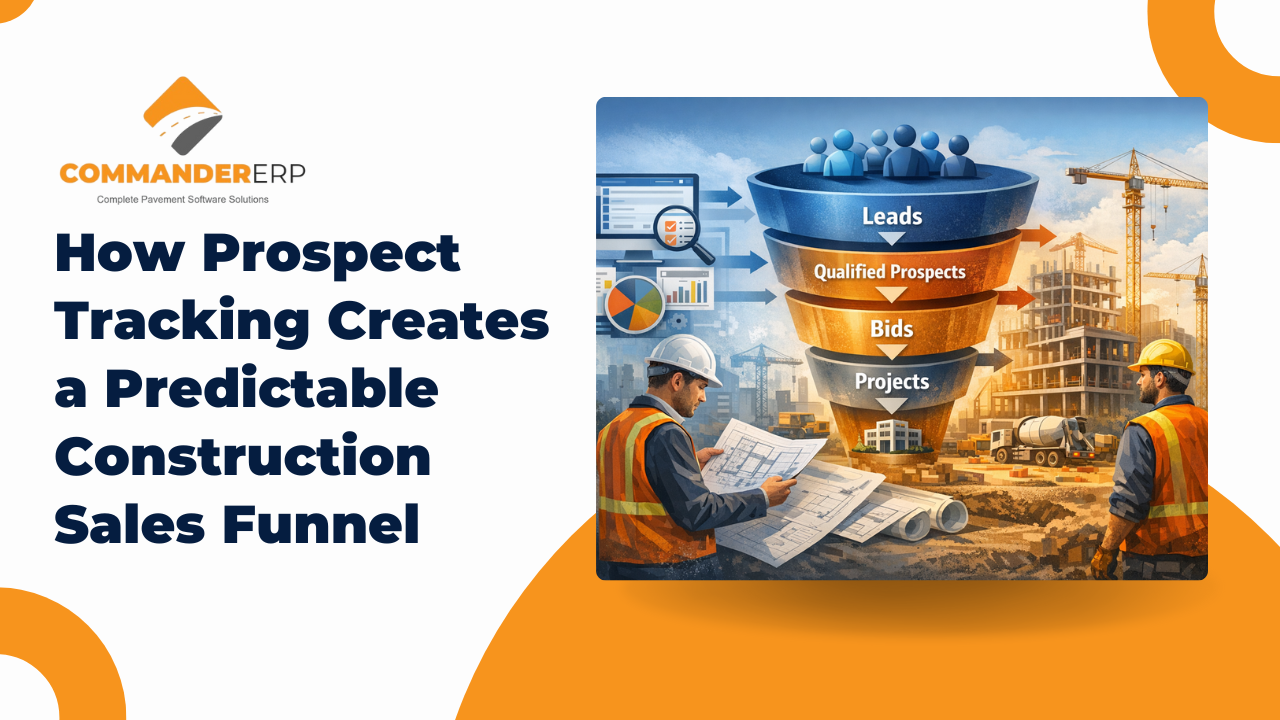
When prospects, opportunities, and bids live in one connected system, the sales funnel stops being theoretical.
It becomes measurable.
You can see how many prospects enter the system, how many turn into real opportunities, how many move forward as bids, and how many finally become projects.
More importantly, you can see where deals stall or drop off.
This visibility allows leadership to improve the process instead of blaming outcomes.
If opportunities are not converting to bids, qualification needs refinement. If bids are not converting to projects, pricing or follow-up strategy may be the issue.
Predictable sales come from fixing the funnel, not pressuring the team.
Closing the Gap Between Sales and Operations
One of the most overlooked benefits of prospect tracking is how it connects sales to delivery.
In Commander ERP, a won bid does not disappear into a separate system.
It flows directly into Projects, carrying forward the original scope, commitments, and expectations.
This continuity reduces handoff errors, protects margins, and ensures project teams understand what was promised during sales.
Finance gains earlier visibility into future revenue, and leadership sees the full lifecycle of each deal.
Sales is no longer a black box—it becomes an integrated part of the business engine.
Reporting That Replaces Guesswork With Confidence
Predictability ultimately comes down to insight. When prospect tracking is done correctly, reporting becomes meaningful.
Instead of relying on gut feeling, construction leaders can monitor pipeline value, conversion trends, and sales cycle timelines using real data.
Company performance dashboards and sales reports provide early warnings long before revenue problems surface.
This allows companies to act proactively rather than reactively. Adjustments are made weeks or months earlier, not after targets are missed.
Why More Leads Won’t Fix a Broken Funnel
Many construction companies respond to inconsistent revenue by chasing more leads.
But volume without structure only increases chaos.
Without prospect tracking, more leads simply mean more missed follow-ups, more estimator fatigue, and more uncertainty.
Predictability does not come from quantity. It comes from control.
A well-tracked prospect pipeline allows companies to grow steadily, confidently, and sustainably.
Final Thoughts
Construction sales will always involve complexity. What it does not need is confusion.
Prospect tracking creates order where there was once uncertainty. It turns sales into a repeatable process rather than a series of isolated efforts.
When prospects move cleanly into opportunities, opportunities into bids, and bids into projects, revenue becomes something you can plan for, not hope for.
Predictable sales is not about selling harder. It’s about tracking smarter.
Build a Predictable Construction Sales Funnel
If your construction sales process still relies on spreadsheets, emails, or disconnected tools, Commander ERP can help you build a structured, predictable sales funnel, from first prospect to final project.
Schedule a demo today and see how prospect tracking transforms construction sales.
