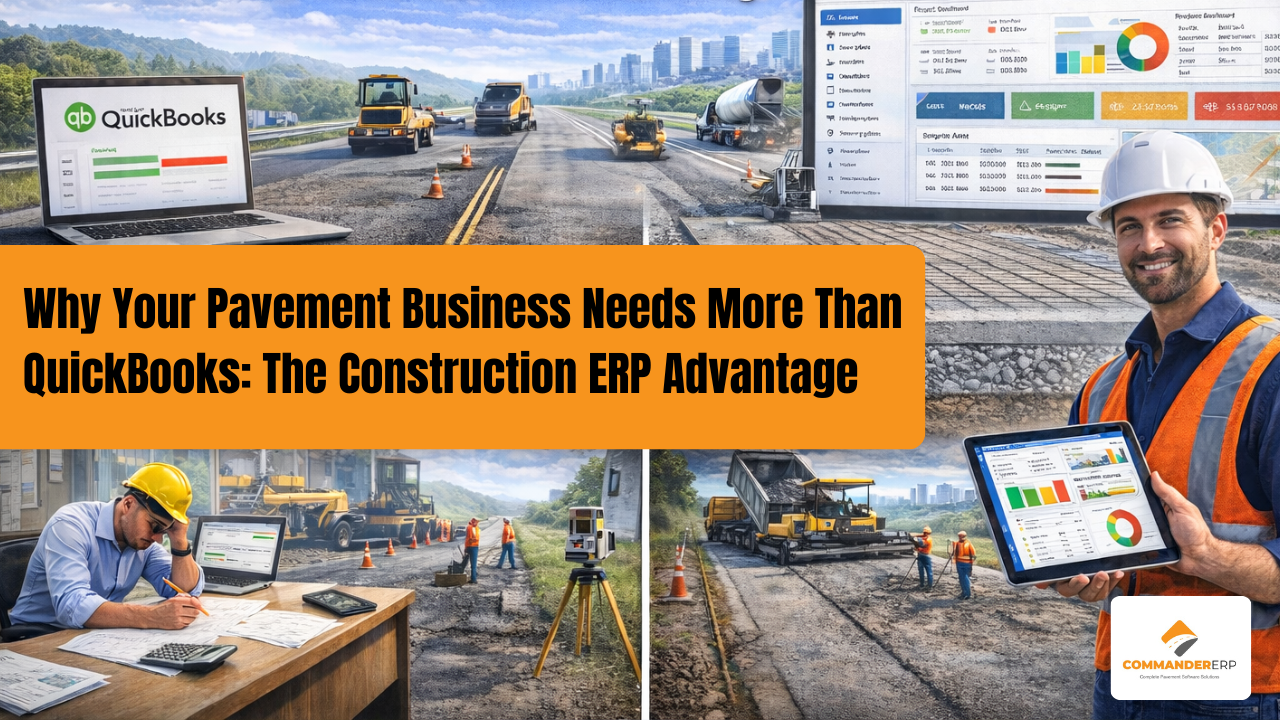
QuickBooks serves millions of small businesses effectively, handling basic accounting tasks like invoicing, expense tracking, and financial reporting. However, pavement contractors face unique operational challenges that general accounting software simply was not designed to address. As your paving business grows beyond a single crew or a handful of concurrent projects, QuickBooks limitations become increasingly apparent and costly.
Construction-specific Enterprise Resource Planning (ERP) systems provide integrated solutions purpose-built for contractors managing complex projects, multiple job sites, equipment fleets, and field crews. Understanding the critical differences between general accounting software and specialized construction ERP helps business owners make informed decisions about technology investments that directly impact profitability and growth potential.
The QuickBooks Problem: Where General Accounting Software Falls Short
Limited Job Costing Capabilities
QuickBooks offers basic job costing features that work adequately for service businesses but prove insufficient for construction projects requiring detailed cost tracking across multiple dimensions. The software struggles to handle complex scenarios pavement contractors face daily, such as tracking costs by project phase, cost code, crew, or equipment unit. Without granular cost visibility, contractors cannot identify which specific activities drain profitability or where operational improvements would deliver the greatest impact.
Real-time job costing represents another critical weakness. QuickBooks typically requires manual data entry and periodic updates, creating lag time between when costs occur and when they appear in reports. By the time contractors realize a project is over budget, substantial losses may have already accumulated. This delayed visibility prevents proactive cost management and forces reactive damage control instead of strategic optimization.
No Integrated Project Management
QuickBooks focuses exclusively on financial transactions, offering no native project management capabilities. Contractors must maintain separate systems for scheduling, resource allocation, and progress tracking, then manually reconcile this information with financial data. This disconnected approach creates inefficiency, increases error risk, and prevents the holistic project visibility modern contractors need for effective decision-making.
Managing multiple concurrent paving projects requires coordinating crews, equipment, materials, and subcontractors across different job sites while monitoring progress against schedules and budgets. QuickBooks provides no tools for these essential functions, forcing contractors to rely on spreadsheets, whiteboards, or memory. As project complexity and quantity increase, these manual methods become unsustainable and error-prone.
Equipment and Fleet Management Gaps
Pavement contractors operate expensive equipment fleets representing significant capital investments requiring careful management. QuickBooks treats equipment as fixed assets for depreciation purposes but offers no functionality for tracking utilization, maintenance schedules, fuel consumption, or per-project equipment costs. Contractors cannot determine which equipment generates positive returns versus sitting idle, or calculate accurate equipment rates for estimating future projects.
Without integrated equipment management, contractors lose visibility into total ownership costs, maintenance timing, and allocation efficiency. They cannot easily answer critical questions like which projects used specific equipment, what utilization rates justify replacement investments, or how equipment costs compare across different job types. This blind spot leads to suboptimal fleet decisions and inaccurate project cost calculations.
What Construction ERP Delivers That QuickBooks Cannot
Comprehensive Job Costing and Profitability Analysis
Construction ERP systems provide sophisticated multi-dimensional job costing that tracks every dollar flowing through projects. Contractors can analyze costs by project, phase, cost code, crew, equipment, material type, or any combination of these dimensions. This granular visibility reveals exactly where money goes, enabling precise identification of profit drivers and cost problems requiring attention.
Real-time cost updates flow automatically from field time entries, material purchases, equipment usage, and subcontractor invoices directly into project accounting. Project managers see current costs versus budgets instantly, allowing immediate corrective action when variances appear. This proactive approach prevents small overruns from becoming catastrophic losses and supports continuous operational improvement based on actual performance data.
Integrated Project and Resource Management
Construction ERP unifies project management with financial tracking in a single platform. Contractors schedule work, allocate crews and equipment, track progress, and monitor costs without switching between disconnected systems. This integration eliminates duplicate data entry, reduces errors, and provides complete project visibility from bid through closeout.
Resource management capabilities ensure optimal deployment of limited crews and equipment across multiple concurrent projects. The system prevents double-booking, highlights utilization gaps, and supports strategic decisions about resource allocation that maximize productivity and profitability. Visual dashboards show resource loading across all projects, making capacity planning and scheduling dramatically more efficient than manual methods.
Purpose-Built for Construction Workflows
Construction ERP understands contractor workflows inherently, requiring minimal customization to support standard industry processes. Features like change order management, progress billing, retainage tracking, and certified payroll reporting work out of the box because the software was designed specifically for construction companies. Contractors spend less time configuring systems and more time using them to run better businesses.
The software speaks construction language, using familiar terminology and reflecting how contractors actually work rather than forcing them to adapt to generic business processes. This industry alignment accelerates user adoption, reduces training time, and ensures that system capabilities align with actual business needs rather than requiring workarounds to accommodate software limitations.
Critical Missing Features in QuickBooks
Mobile Field Access and Data Collection
Modern pavement contractors need mobile capabilities allowing field personnel to record time, document progress, capture photos, and update project status from job sites. QuickBooks offers limited mobile functionality focused primarily on expense tracking and invoicing, with no robust field data collection tools. This forces contractors to use paper timesheets and manual processes that delay information flow and introduce transcription errors.
Construction ERP mobile applications transform smartphones and tablets into powerful business tools. Crew foremen clock in employees, record equipment hours, document material usage, and note project conditions in real-time. This immediate data capture eliminates paperwork, improves accuracy, and gives office staff instant visibility into field operations. Project managers can check current job status from anywhere rather than waiting for end-of-day reports or making phone calls.
Estimating and Bid Management
QuickBooks provides no estimating functionality beyond creating simple quotes. Pavement contractors preparing detailed quantity takeoffs, building comprehensive cost estimates, and managing multiple concurrent bids need specialized tools that QuickBooks cannot provide. Contractors must maintain separate estimating software or spreadsheets, then manually transfer won bid data into QuickBooks for project setup and tracking.
Construction ERP includes integrated estimating that leverages historical cost databases to improve accuracy while accelerating bid preparation. Once bids are won, estimates convert directly into project budgets with one click, ensuring consistency between what was quoted and what gets tracked. This seamless flow eliminates redundant data entry while enabling powerful bid versus actual analysis that continuously improves estimating precision.
Equipment Cost Tracking and Utilization
Accurately allocating equipment costs to specific projects proves nearly impossible in QuickBooks. Contractors cannot easily track which equipment worked on which projects, calculate per-hour equipment costs including fuel and maintenance, or analyze utilization rates across their fleet. This limitation produces inaccurate project costs and prevents data-driven equipment investment decisions.
Construction ERP tracks equipment deployment to specific projects automatically as operators log hours through mobile applications or equipment tracking systems. The software calculates complete equipment costs including depreciation, fuel, maintenance, insurance, and financing, then allocates these costs to projects based on actual usage. Contractors gain precise visibility into equipment profitability and can optimize fleet composition based on real utilization data rather than gut feelings.
The Real Cost of Using QuickBooks for Construction
Hidden Inefficiencies and Lost Productivity
QuickBooks limitations force contractors to maintain multiple disconnected systems and manual processes that consume substantial time and resources. Staff spend hours each week transferring data between estimating spreadsheets, project schedules, time tracking tools, and accounting records. This duplicate effort wastes labor that could focus on productive activities while introducing errors that require additional time to identify and correct.
Manual workarounds to compensate for missing functionality create ongoing productivity drains. Project managers waste time compiling job cost reports from multiple sources rather than accessing comprehensive dashboards. Owners cannot quickly answer critical questions about profitability, cash flow, or resource utilization because the information exists in fragmented systems requiring manual aggregation. These inefficiencies compound as businesses grow, eventually becoming unsustainable.
Inaccurate Job Costing Leading to Lost Profits
Without real-time, granular job costing, contractors often discover cost overruns too late for effective remediation. Projects that seemed profitable during execution reveal losses only after completion when all costs finally get recorded. This delayed recognition prevents learning from mistakes quickly and results in repeated errors across multiple projects before patterns become apparent.
Inaccurate cost data also undermines estimating accuracy for future bids. When historical project costs contain gaps or errors, estimates based on this flawed data perpetuate inaccuracies. Contractors either leave money on the table through overly conservative pricing or lose bids through unrealistically low estimates. Either outcome damages profitability and competitive positioning in ways that proper cost tracking could prevent.
When to Upgrade from QuickBooks to Construction ERP
Growth Stage Indicators
Most pavement contractors can manage with QuickBooks during early growth when handling one or two projects simultaneously with a single crew. However, clear signals indicate when businesses have outgrown general accounting software and need specialized construction management tools. Running three or more concurrent projects creates complexity that manual coordination cannot handle efficiently, making integrated project management essential.
When owners spend more time managing systems than managing business, or when project managers cannot quickly answer questions about current costs or resource availability, the business has exceeded QuickBooks capabilities. Similarly, if estimating relies heavily on guesswork rather than historical data, or if profitability seems unpredictable despite steady revenue, better cost tracking and analysis tools will deliver immediate value.
Calculating Return on Investment
Construction ERP represents a significant investment requiring careful evaluation, but the returns often justify costs within the first year of implementation. Calculate potential savings from reduced administrative time, fewer billing errors, improved cash flow from faster invoicing, and better resource utilization preventing idle equipment and crews. Even modest improvements in these areas typically exceed software costs substantially.
The larger return comes from improved profitability through better project management and cost control. If construction ERP helps increase average project margins by just one or two percentage points through better cost visibility and proactive management, the profit improvement on annual revenue quickly dwarfs software expenses. Add competitive advantages from faster, more accurate estimating and the ability to manage more projects with existing staff, and ROI becomes compelling.
Making the Transition: Implementation Considerations
Data Migration and System Integration
Transitioning from QuickBooks to construction ERP requires careful planning to ensure smooth data migration and minimal business disruption. Most modern ERP systems offer tools or services for importing customer lists, vendor information, chart of accounts, and historical financial data from QuickBooks. This automated migration reduces manual effort while ensuring accuracy in transferring critical information.
Some contractors maintain QuickBooks temporarily for historical reference while building new data in construction ERP, providing safety and comfort during transition periods. Others choose clean breaks, migrating essential data and starting fresh with improved processes. The right approach depends on business complexity, historical data importance, and available implementation support. Either way, cloud-based construction ERP typically enables faster, less disruptive implementations than legacy on-premise systems.
Training and User Adoption
Successful ERP implementation requires more than software installation; it demands organizational commitment to new processes and user training ensuring everyone can leverage system capabilities effectively. Modern construction ERP platforms emphasize user-friendly interfaces requiring less training than older systems, but comprehensive onboarding still proves essential for realizing full value.
Focus training on how new capabilities solve current pain points rather than simply teaching button-clicking. When staff understand how real-time cost visibility helps them make better decisions, or how mobile time entry eliminates paperwork they dislike, they embrace change enthusiastically. Start with core users who influence others, build early successes demonstrating value, then expand adoption across the organization with momentum from demonstrated benefits.
Cloud-Based Construction ERP: Modern Advantages
Accessibility and Real-Time Collaboration
Cloud-based construction ERP delivers information access from anywhere with internet connectivity, enabling owners to check business status while traveling, project managers to review costs from job sites, and estimators to update bids from home offices. This flexibility supports modern work styles while ensuring everyone works from current, accurate data rather than outdated exports or disconnected spreadsheets.
Real-time collaboration becomes possible when all users access the same cloud database simultaneously. Field crews enter time and material usage while office staff process invoices and update schedules, with changes immediately visible to everyone. This synchronized operation eliminates version control problems and reduces communication overhead, as team members can see current project status directly rather than requesting updates through phone calls or emails.
Lower IT Burden and Automatic Updates
Cloud ERP eliminates server hardware investments, backup management, and software update responsibilities that burden contractors using on-premise systems. The vendor handles infrastructure maintenance, security patches, and feature updates automatically, ensuring contractors always run current software versions without IT staff intervention. This managed approach proves especially valuable for smaller contractors lacking dedicated IT resources.
Automatic updates mean contractors benefit from continuous product improvements without expensive upgrade projects. New features, enhanced capabilities, and improved interfaces roll out seamlessly without business disruption. Cloud platforms also scale effortlessly as businesses grow, accommodating more users, projects, and data without performance degradation or hardware upgrades. This scalability supports growth without technology constraints.
Conclusion
QuickBooks serves basic accounting needs adequately but cannot deliver the sophisticated project management, cost tracking, and operational capabilities pavement contractors require for profitable growth. As businesses expand beyond simple operations with single crews and sequential projects, the limitations of general accounting software create expensive inefficiencies, inaccurate cost data, and missed profit opportunities that specialized construction ERP prevents.
Construction-specific ERP systems provide integrated solutions addressing the unique complexities contractors face managing multiple projects, diverse resources, and field operations. The transition from QuickBooks to construction ERP represents a strategic investment in business capability that pays dividends through improved profitability, operational efficiency, and growth support. While change requires effort and commitment, the competitive advantages and financial returns make construction ERP essential for contractors serious about building sustainable, profitable businesses.
For pavement contractors ready to move beyond QuickBooks limitations, modern cloud-based solutions like Commander ERP offer accessible entry points with construction-specific functionality, mobile capabilities, and seamless integration designed specifically for paving operations. These platforms transform how contractors manage projects, track costs, and make decisions, delivering the visibility and control that general accounting software simply cannot provide.
