2026-08-27

Construction companies today are under pressure to deliver faster, manage more crews, and keep projects profitable despite rising labor and material costs. But the biggest struggle is not the work itself, it’s the scattered systems used to manage it.
Time tracking happens in one tool, tasks and scheduling in another, payroll in spreadsheets, and project management somewhere else entirely. This fragmented approach creates confusion, slows teams down, and allows costly mistakes to slip through unnoticed.
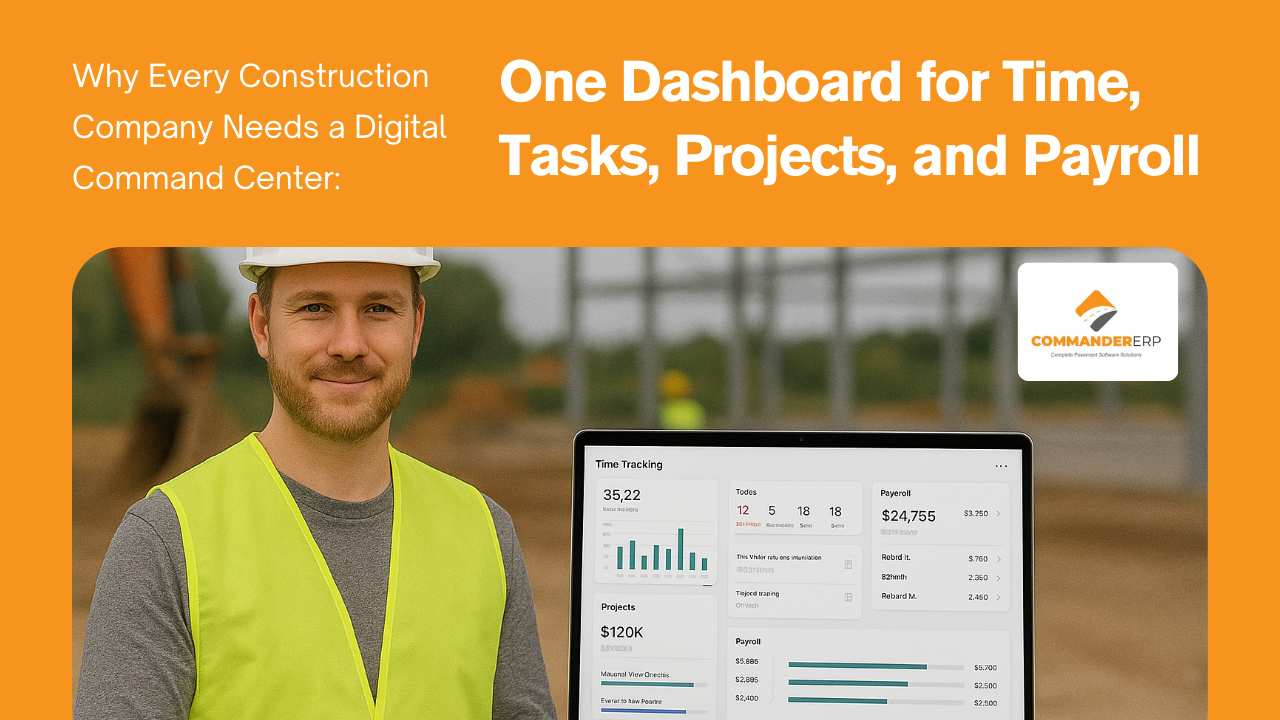
The solution modern contractors are switching to is a Digital Command Center: a single dashboard that brings every core operational function together. With Commander ERP, construction companies finally get one platform that connects Time Tracker, Task Scheduling, Projects, and Payroll into a real-time operational hub. The result is faster decisions, higher productivity, and complete visibility across the entire business.
Most construction companies use multiple disconnected systems because they added tools over the years as new problems came up. One app for clock-ins, one for project planning, one for payroll calculation, and one for crew task assignments.
While each tool solves a specific problem, none of them talk to each other. This leaves managers guessing whether the time logged matches the tasks assigned, whether payroll reflects actual work completed, or whether project delays are happening before it is too late.
Because information is scattered, teams waste hours reconciling timesheets, confirming labor data, and updating schedules manually. Decisions slow down because leaders don’t have a single place to see what is really happening on the ground. As the company grows, these inefficiencies become expensive and unsustainable.
A Digital Command Center solves all these issues by bringing every core operation onto one connected dashboard. Instead of jumping between five different tools to understand the day, managers get real-time clarity in one place.
When the system connects time logs with tasks, projects, and payroll, contractors no longer need to piece together information manually. They can instantly see who is working, what they are working on, how far the project has progressed, and how much the labor is costing, all without switching screens. With unified operations, miscommunication drops, errors shrink, and teams stay aligned from field to office without relying on calls, texts, or spreadsheets.
Time Tracker becomes far more powerful when it feeds data directly into every other part of the system. In Commander ERP, each clock-in automatically links to the assigned task, crew, job, and cost code. This connection removes guesswork and ensures that time data is always accurate.
Managers can see, in real time, which crews are active, where hours are being spent, and whether the logged time aligns with expected progress. Because time is the foundation of labor cost, productivity, and payroll, having this data centralized is essential for running a modern construction operation without errors or delays.
Task Scheduling becomes dramatically more effective when tied to the same dashboard. Instead of creating schedules manually or adjusting them based on incomplete information, managers get full visibility into crew availability, job priorities, and actual progress.
Commander ERP allows companies to assign tasks based on live data from Time Tracker, so scheduling always reflects what is happening on the ground. When a task is delayed or completed early, managers see the impact immediately and adjust workflows accordingly. This prevents bottlenecks, reduces idle time, and ensures crews move seamlessly from one task to the next without confusion.
When project management operates separately, managers are forced to rely on outdated or incomplete data when making decisions. Commander ERP eliminates this problem by connecting project progress with real-time time logs and task updates.
As crews complete tasks, the project status updates instantly. Managers no longer need to request progress reports or track down information manually. This gives a true, live picture of the project timeline, budget, and resource allocation.
Contractors can identify risks early, prevent delays, and keep projects on schedule because the Digital Command Center aligns planning with execution every minute of the day.
Payroll becomes significantly easier and more accurate when it is powered by real-time time tracking. With Commander ERP, payroll pulls directly from validated time logs that are tied to tasks and job codes. This stops overpayments, eliminates ghost hours, and ensures overtime is calculated correctly based on actual work. The system also reduces administrative workload because there is no need to re-enter or cross-check data between tools.
Payroll accuracy improves, processing time drops, and workers are paid on schedule with complete transparency. For busy contractors managing multiple crews, this single connection saves hours every week and prevents costly labor mistakes.
A Digital Command Center gives construction leaders a single screen that shows the full operational health of the company. Time, tasks, project progress, and payroll all update in real time, giving managers complete visibility without digging through files, apps, or spreadsheets.
Leaders can see which projects are ahead or behind, which crews are underutilized, where labor is costing more than expected, and what adjustments need to be made immediately. This level of insight helps companies stay proactive instead of reactive. With all information living in one place, decisions become faster, more accurate, and more aligned with the company’s goals.
Construction companies that continue operating with scattered tools will face more delays, more miscommunication, and higher labor costs over time. A Digital Command Center is no longer optional, it’s the new standard for running a modern contracting business. Commander ERP unifies Time Tracker, Task Scheduling, Projects, and Payroll into one connected dashboard, giving contractors complete control and clarity. When everything is managed and monitored from a single system, companies work smarter, finish projects faster, reduce waste, and operate with full confidence in the data that drives their business forward.