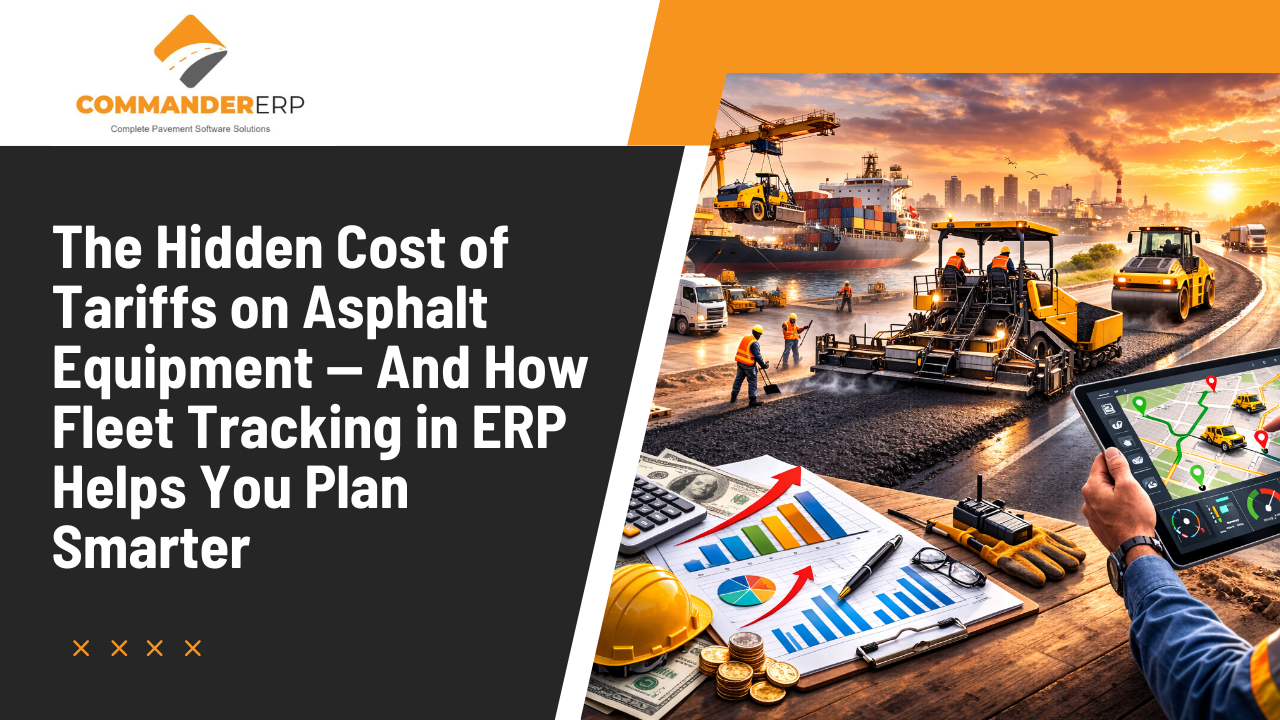
If you've bought equipment, ordered parts, or replaced tires on your paving fleet recently, you already know something is different. Prices are higher. Lead times are longer. And the quotes you're getting today look nothing like what you paid two years ago.
The cause is no mystery — tariffs on imported steel, aluminum, and manufactured goods have sent ripple effects through the construction and pavement equipment supply chain. Asphalt pavers, rollers, milling machines, compactors, and the parts that keep them running are all affected. And the contractors who are getting hurt the most aren't the ones who bought new equipment — they're the ones who didn't see the cost increases coming and weren't tracking the right numbers to respond.
This article breaks down exactly how tariffs are impacting asphalt equipment costs in 2025, what it means for your operating margins, and how fleet tracking inside a cloud-based ERP like Commander ERP gives you the visibility to plan smarter — before the next price shock hits.
What's Actually Driving Equipment Costs Up for Pavement Contractors
Tariffs don't hit contractors in one clean line item. They work their way through the cost structure over months, showing up in places that are easy to miss if you're not tracking carefully.
Steel and Aluminum Tariffs
Most heavy pavement equipment — pavers, rollers, tandem drums, motor graders — is built from steel and aluminum. Tariffs on imported steel and aluminum have increased manufacturing costs for domestic and imported equipment alike, pushing purchase prices and replacement costs higher across the board.
25%+ steel tariff rates are in effect in 2025, directly affecting heavy equipment manufacturing costs.
Parts and Components
Even if you're not buying new equipment, you're feeling tariff pressure every time you order replacement parts. Hydraulic components, engine parts, cutting edges, conveyor components — a significant portion of aftermarket parts for paving equipment come from supply chains that cross tariff-affected borders. Repair costs that were predictable two years ago are now unpredictable and frequently higher.
Fuel and Lubricants
Energy and commodity price volatility — influenced in part by trade policy shifts — has kept diesel prices elevated and unpredictable. For asphalt contractors running a fleet of heavy equipment, fuel is often the second or third largest project cost. When fuel prices spike mid-season, job margins that looked solid at bid time can erode quickly.
Import-Dependent Specialty Equipment
Certain categories of pavement equipment — line stripers, specialty crack filling equipment, infrared repair units — rely heavily on imported components or are manufactured overseas. These have seen some of the sharpest price increases, and lead times for new units or replacement parts have stretched significantly.
The contractors getting hurt most by tariff-driven cost increases aren't the ones who paid more for equipment — they're the ones who didn't know what their equipment was actually costing them per job, and couldn't adjust fast enough when prices changed.
The Real Problem: Most Paving Companies Don't Know Their True Fleet Costs
Here's what makes tariff-driven cost increases so damaging for pavement businesses: most contractors don't have clean, job-level visibility into what their fleet is actually costing them.
Fuel receipts go into a shoebox or a spreadsheet. Maintenance invoices get paid and filed. Equipment hours are tracked in someone's head or on a whiteboard. And at the end of the season, the total equipment cost number on the P&L is a surprise — usually an unpleasant one.
When you're operating this way, tariff-driven price increases are invisible until they've already damaged your margins. You bid a job based on last year's fuel costs. You schedule a repair based on last year's parts prices. And somewhere between the bid and the final invoice, your profit margin quietly disappears.
The questions every pavement contractor should be able to answer — but most can't — include:
- What is my average fuel cost per project by equipment type?
- Which pieces of equipment have the highest maintenance cost per hour of operation?
- How much have my repair costs increased in the last 12 months compared to the prior year?
- Which jobs are most sensitive to fuel price changes — and how should I adjust my bids?
- When is each piece of equipment due for service, and what will it cost?
If you can't answer these questions with data, you're managing your fleet by feel. And in a cost environment shaped by tariffs and supply chain volatility, that's a serious risk.
How Fleet Tracking in Commander ERP Changes the Equation
Commander ERP's Fuel & Maintenance module is designed to give pavement contractors exactly the visibility they need to manage fleet costs intelligently — not reactively. Here's how it works in practice.
Track Fuel Costs by Vehicle, Equipment, and Project
Every fuel transaction can be logged against a specific piece of equipment and a specific project inside Commander ERP. That means at the end of a job, you don't just know your total fuel spend — you know which equipment consumed the most, which projects had the highest fuel cost ratios, and how your actual costs compared to what you budgeted at bid time. When diesel prices spike due to tariff-related energy volatility, you can immediately see which projects are most affected and adjust your bidding strategy for upcoming work. Instead of discovering the overrun after the job is closed, you catch it in real time.
Centralize Maintenance Schedules and Repair Records
One of the most expensive things that happens in a pavement business is deferred maintenance — equipment that should have been serviced gets pushed another week, then another, until a minor issue becomes a major repair at the worst possible time. Commander ERP's maintenance tracking module keeps all service schedules, completed repairs, and upcoming maintenance needs in one place. You can see at a glance which equipment is due for service, what each service will cost based on prior history, and which pieces of your fleet are costing disproportionately more to maintain. In a tariff environment where parts prices are elevated and unpredictable, this kind of proactive scheduling also gives you the ability to order parts and schedule service when pricing is favorable — rather than paying emergency prices when something breaks mid-season.
Build Real Cost History for Smarter Bidding
Every fuel log and maintenance record you enter into Commander ERP becomes historical data that makes your next bid more accurate. Over time, you build a clear picture of what each piece of equipment actually costs to operate per day, per hour, or per project type. That historical data is what lets you adjust your bids intelligently as equipment costs change. When steel tariffs push up your repair costs by 15%, you can see exactly how that affects your per-job cost structure — and price accordingly, rather than guessing and hoping your margins hold.
Monitor Fleet Costs Against Project Budgets
Through Commander ERP's Company Performance module, fleet costs don't live in isolation — they're tied to the projects that generated them. You can run Fuel Reports and cross-reference them against Operations Reports and Sales Reports to see exactly where equipment costs are eating into your project margins. This is the visibility that separates contractors who manage their margins from contractors who discover problems after the fact. When a single project's fuel costs are tracking 20% above budget mid-job, you know it in time to do something about it — not when you're reviewing the year-end P&L in January.
Equipment Planning in a Tariff Environment: A Practical Framework
Beyond day-to-day tracking, tariffs and supply chain uncertainty create a longer-term equipment planning challenge for pavement contractors. Here's a practical framework for thinking through your fleet decisions given the current cost environment:
Assess Your Current Fleet's True Cost Per Hour
Before making any purchase, replacement, or lease decision, you need to know what your existing equipment actually costs to operate — including fuel, maintenance, repairs, and downtime. Commander ERP's fleet tracking gives you this data if you've been logging consistently. If you haven't, now is the time to start — every month of clean data improves your decision-making.
Identify High-Cost Equipment Before It Becomes a Crisis
Not all equipment ages the same way. Some pieces of your fleet will reach a tipping point where repair costs exceed the cost of replacement — but without tracking, you won't know when that threshold is approaching. Reviewing maintenance cost trends inside Commander ERP lets you proactively identify aging equipment and plan replacements on your timeline, not the equipment's.
Factor Tariff-Adjusted Costs Into Your Bid Templates
If you're using historical fuel and maintenance averages in your bids, make sure those averages reflect current pricing — not pre-tariff pricing from two or three years ago. Commander ERP lets you run period-specific cost reports so you're always bidding based on what things actually cost today, not what they cost before the supply chain shifted.
Build a Maintenance Reserve Based on Real Data
One of the smartest things a pavement contractor can do in a volatile cost environment is build a maintenance reserve — a budget line specifically for fleet repairs and parts that accounts for current price levels. The only way to size that reserve accurately is with real cost history. Commander ERP provides exactly that.
The Competitive Advantage of Knowing Your Numbers
In a market where equipment and fuel costs are rising unpredictably, the contractors who win aren't necessarily the ones with the newest equipment or the lowest overhead. They're the ones who know their numbers with precision and can adjust faster than their competitors.
| Without Fleet Tracking | With Commander ERP Fleet Tracking |
|---|---|
| Bid fuel costs based on memory or old averages | Bid using current, project-specific fuel cost data |
| Discover repair cost overruns after jobs close | Flag cost overruns mid-project in real time |
| Defer maintenance until equipment breaks | Schedule maintenance proactively by cost history |
| No data to justify equipment replacement timing | Data-driven replacement decisions by cost-per-hour |
| Tariff increases silently erode margins | Cost increases are visible and immediately actionable |
| Year-end surprises on equipment P&L | Monthly visibility into fleet cost trends |
Tariffs are an external factor — you can't control them. But your response to them is entirely within your control. And the first step toward a smarter response is knowing exactly what your fleet is costing you, right now, at the job level.
Every dollar of tariff-driven cost increase that you can see is a dollar you can manage. Every dollar you can't see is a dollar that quietly disappears from your profit margin.
Your Fleet Cost Control Action Plan for 2025
- Start logging all fuel transactions by equipment and project in Commander ERP — today, not next season.
- Enter all outstanding maintenance records and upcoming service schedules into the Fuel & Maintenance module.
- Run a 12-month fleet cost report — identify your highest-cost equipment by maintenance spend.
- Compare your current fuel cost averages against what you used in your last 5 bids — adjust if needed.
- Build a tariff-adjusted maintenance reserve into your overhead budget for the current season.
- Set quarterly fleet cost reviews on your calendar — treat fleet cost management as a standing business practice.
Stop Guessing What Your Fleet Is Costing You
Download our free Fleet Cost Control Worksheet for Pavement Contractors — a practical tool to calculate your true cost per equipment hour, identify your highest-cost assets, and build a tariff-adjusted maintenance budget inside Commander ERP.
Download the Free Fleet Cost Control WorksheetStart your free trial of Commander ERP — no credit card required.
Fleet Cost Control Worksheet for Pavement Contractors
Use this worksheet to calculate your true per-hour and per-project fleet costs, identify cost overruns, and build a tariff-adjusted equipment budget for the current season.
Section 1 — Equipment Inventory & Cost Baseline
- List each piece of equipment in your fleet: Name / Year / Make / Model
- Current estimated replacement value: $___________
- Total maintenance spend last 12 months: $___________
- Total fuel consumption last 12 months (gallons): ___________
- Estimated hours of operation last 12 months: ___________
- Calculated cost per operating hour: $___________ (Total costs ÷ hours)
Section 2 — Tariff Impact Assessment
- Average parts/repair cost per service event (last 12 months): $___________
- Average parts/repair cost per service event (prior 12 months): $___________
- Year-over-year cost increase %: ___________%
- Estimated tariff-driven cost increase per season: $___________
- Which equipment categories have seen the largest cost increases? ___________
Section 3 — Fuel Cost by Project Type
- Average fuel cost per day for paving projects: $___________
- Average fuel cost per day for repair/patching projects: $___________
- Average fuel cost per day for sealcoating projects: $___________
- Average fuel cost per day for striping projects: $___________
- Note: Update these figures in Commander ERP bid templates each season.
Section 4 — Maintenance Schedule Review
- Equipment overdue for scheduled maintenance: ___________
- Parts currently on order or with extended lead times: ___________
- Equipment approaching replacement threshold (high cost per hour): ___________
- Estimated maintenance budget for next 6 months: $___________
Section 5 — Bid Adjustment Checklist
- Have you updated fuel cost averages in your bid templates to reflect current prices? Yes / No
- Have you added a tariff contingency line to bids involving major equipment? Yes / No
- Are your maintenance reserve costs reflected in your overhead calculation? Yes / No
- Have you reviewed your top 5 upcoming bids against current fleet cost data? Yes / No
Section 6 — Annual Fleet Cost Summary
- Total fleet fuel cost (annual): $___________
- Total fleet maintenance and repair cost (annual): $___________
- Total fleet operating cost (annual): $___________
- Fleet cost as % of total revenue: ___________%
- Target fleet cost % for next season: ___________%
