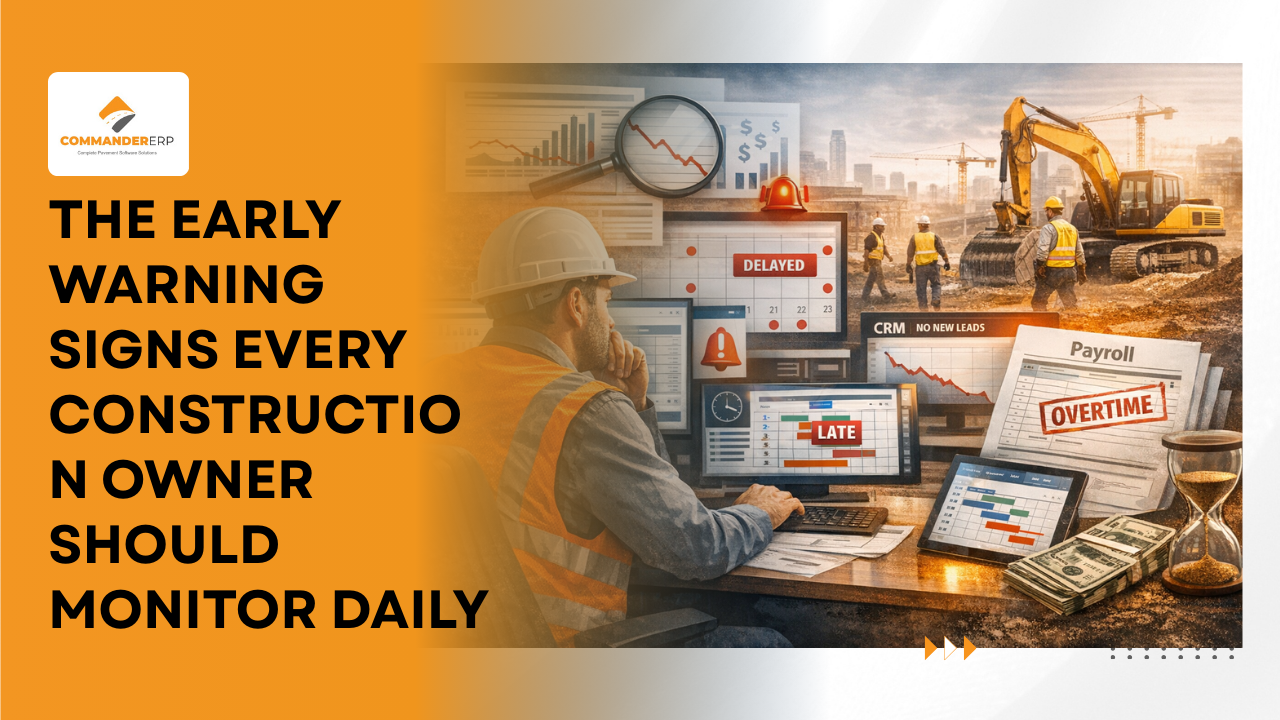
Construction Businesses Rarely Fail Suddenly, They Give Signals Every Single Day
Most construction owners don’t miss the warning signs because they’re careless. They miss them because those signs don’t look dangerous at first.
Work is still moving. Crews are on site. Invoices are going out. From the outside, everything looks “normal.”
But construction businesses don’t fail overnight. They fail when daily operational signals are ignored long enough to become financial damage. The earlier those signals are monitored, the easier they are to correct.
The problem is not lack of experience.
The problem is lack of daily visibility.
When Today’s Company Performance Is Unclear, Tomorrow’s Decisions Become Risky
Construction owners often review performance weekly or monthly, assuming daily monitoring is unnecessary.
That delay is costly.
When company performance isn’t visible in real time, leaders don’t notice margin erosion, rising labor costs, or productivity drops until the trend is already established. Human psychology prefers delayed evaluation because it feels less stressful, but delay is exactly what allows small problems to grow.
Daily company performance visibility turns management from reactive to preventive. It allows owners to course-correct while the impact is still minimal.
Time Tracking Inconsistencies Are One of the Earliest Profit Warnings
Payroll rarely creates immediate alarm. That’s why it’s dangerous.
Inaccurate time entries, delayed approvals, and unverified overtime don’t feel urgent day to day. Over time, however, they quietly distort labor costs and reduce profitability.
Construction owners often trust that “it will balance out.” In reality, it never does.
Daily time tracking visibility and historical time logs expose small discrepancies before they become permanent payroll leaks. When time data is reviewed daily, control returns without conflict.
Project Delays Start Small and Multiply Without Daily Oversight
Projects don’t fall behind suddenly. They drift.
- A task pushed to tomorrow
- A schedule adjustment without follow-up
- Unclear responsibility for a delayed activity
Without daily project and task visibility, these minor shifts accumulate across multiple jobs. By the time a project looks “off track,” recovery is expensive.
Daily monitoring of project progress and task schedules allows construction owners to intervene early, when adjustment is simple and cost-effective.
Also Read: Why Every Construction Company Needs a Digital Command Center
Employee Activity Patterns Reveal Problems Before Performance Drops
Employee productivity issues don’t usually begin with poor effort. They begin with misalignment.
- Unclear expectations
- Disconnected priorities
- Lack of accountability visibility
Daily employee dashboards reveal work patterns before performance declines. They show whether teams are focused, overloaded, or misdirected, allowing leaders to correct course without confrontation.
When employee activity is visible, accountability becomes natural rather than forced.
CRM Silence Is a Daily Warning Sign Most Owners Ignore
Sales problems don’t announce themselves loudly.
- Leads slow slightly
- Follow-ups stretch longer
- Opportunities sit without movement
Individually, these changes seem harmless. Collectively, they signal future revenue loss.
Daily CRM visibility ensures construction owners can see pipeline health before revenue drops appear in financial reports. Sales momentum is easiest to fix when it’s still moving, not after it stalls.
Missed Alerts and Unreviewed Reports Are Silent Risk Multipliers
Ignoring notifications, postponing report reviews, or “catching up later” creates blind spots.
Construction operations move too fast for delayed attention. Daily review of alerts, performance signals, and operational summaries ensures problems are identified when they are still manageable.
Silence is not stability. It’s accumulated risk.
Why Daily Monitoring Protects Construction Owners from Stress and Crisis
Daily visibility doesn’t increase workload; it reduces it.
When construction owners know exactly what’s happening today, they stop worrying about what might surface tomorrow. Stress comes from uncertainty, not awareness.
Commander ERP centralizes dashboards, time tracking, project updates, payroll signals, and CRM activity into one daily command center, giving owners control without micromanagement.
The Most Dangerous Mistake Is Believing You’ll “Notice When Something’s Wrong”
Experience is valuable, but it’s not a monitoring system.
By the time something feels wrong, it usually is—and has been for a while.
Construction businesses that monitor daily signals stay adaptable. Those that don’t are forced into damage control.
Early Warning Signs Appear Every Day, But Only Visible Systems Reveal Them
Commander ERP gives construction owners real-time insight into performance, people, projects, time, payroll, and sales before problems become expensive.
Book a Commander ERP demo today and turn daily visibility into long-term control.
