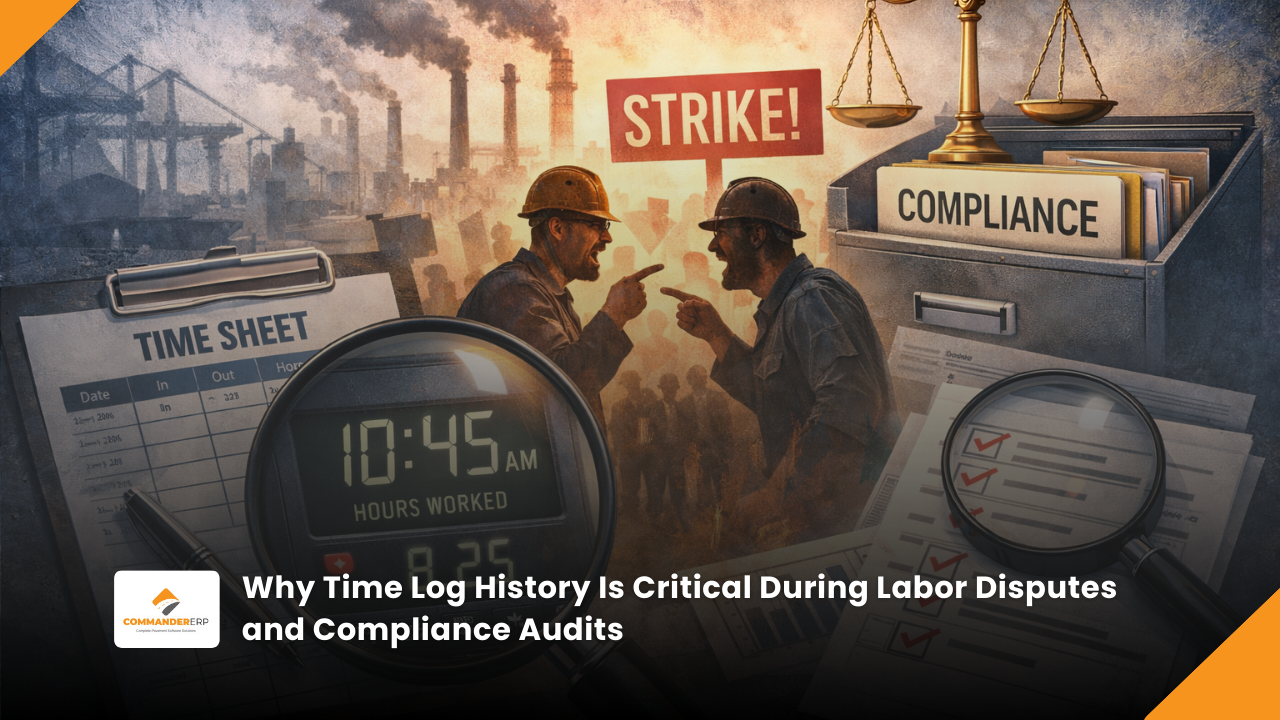
Why Do Labor Disputes Almost Always Come Down to One Question?
In construction and pavement management companies, labor disputes rarely revolve around intent. They usually come down to a single question: what actually happened. How many hours were worked, when the work was done, and who approved it. When answers rely on memory, handwritten logs, or delayed spreadsheets, disputes escalate quickly.
Time log history inside a cloud-based ERP pavement management system replaces assumptions with verified data. When records are accurate, disputes become easier to resolve and often prevent escalation altogether.
What Happens When Time Records Are Incomplete or Inconsistent?
Incomplete or inconsistent time records create uncertainty. Employees feel underpaid, employers feel exposed, and compliance teams struggle to justify payroll decisions. In construction environments where work happens across sites and schedules change frequently, these gaps become dangerous.
Without a centralized time log history, companies rely on reconstructed timelines. This leads to prolonged disputes, loss of trust, and potential legal exposure. A reliable construction ERP ensures that every hour worked is recorded, stored, and traceable.
Why Is Time Log History the First Thing Auditors Ask For?
During labor compliance audits, time log history is often the first document requested. Auditors are not interested in estimates or summaries. They need detailed records showing when work started, when it ended, and how hours were calculated.
A cloud-based ERP pavement management system maintains this history automatically. Each time entry is tied to an employee, project, and date, creating a defensible audit trail. This level of transparency reduces audit stress and demonstrates compliance with labor regulations.
How Do Time Logs Protect Both Employers and Employees?
Time log history is not just a management tool. It protects employees by ensuring they are paid accurately for every hour worked. It also protects employers by providing evidence when disputes arise.
When both parties reference the same verified data, conversations shift from accusations to resolution. A construction ERP system creates a shared source of truth that balances fairness with accountability.
Why Are Manual Time Logs Risky in Legal Situations?
Manual time logs are vulnerable to errors, manipulation, and loss. Handwritten entries can be unclear, altered, or forgotten. Spreadsheets can be edited without a clear history of changes. In legal or compliance situations, these weaknesses undermine credibility.
Digital time log history inside a cloud-based ERP provides timestamps, approvals, and historical records that cannot be easily disputed. This reliability becomes critical when companies must defend payroll decisions or labor practices.
How Does Real-Time Time Logging Prevent Disputes Before They Start?
Disputes often arise weeks or months after work is completed. By that time, memories fade and details become unclear. Real-time time logging changes this by capturing data at the moment work happens.
Employees review their entries daily, supervisors approve them promptly, and payroll is calculated from verified records. Errors are corrected early, long before they become formal complaints or audit findings.
Why Is Approval History Just as Important as Logged Hours?
During audits and disputes, approval records matter as much as the hours themselves. Auditors and legal teams need to see not only what was logged, but who approved it and when.
A construction ERP system maintains a clear approval history within the time log record. This demonstrates oversight, process control, and compliance. Approval history shows that hours were reviewed, not blindly accepted.
How Does Time Log History Support Compliance With Labor Laws?
Labor regulations often require employers to maintain accurate records for a specific period. Missing or inconsistent data can result in penalties, back payments, or legal action.
A cloud-based ERP pavement management system automatically stores time log history securely and accessibly. Companies can retrieve records quickly when required, reducing compliance risk and administrative burden.
What Role Does Project-Based Time Tracking Play in Audits?
In construction and pavement management, time tracking is closely tied to project costing and billing. Auditors may request proof that labor hours were allocated correctly across projects.
Time log history linked to projects provides this clarity. Each entry shows where labor was applied, supporting accurate costing and compliance. This level of detail strengthens both financial and operational audits.
Why Does Centralized Time Log History Reduce Management Stress?
When time records are scattered across systems, preparing for audits or disputes becomes a time-consuming scramble. Management spends valuable hours collecting data instead of focusing on operations.
A centralized time log history inside a construction ERP eliminates this chaos. Records are always available, organized, and ready for review. This preparedness reduces stress and improves confidence during audits.
Why Cloud-Based ERP Is Essential for Reliable Time Records?
Construction teams work across multiple locations and schedules. A cloud-based ERP pavement management system ensures time logs are captured consistently, regardless of where work happens.
Commander ERP provides a secure, centralized platform where time log history is preserved in real time. This consistency is critical for maintaining accurate records and defending them when challenged.
What Does Strong Time Log History Say About Your Business?
Accurate time log history signals professionalism, compliance, and respect for labor. It shows that a company values transparency and accountability. In disputes and audits, this reputation matters.
Construction companies with strong time tracking systems resolve conflicts faster, pass audits more smoothly, and maintain better relationships with employees and regulators.
Looking for a Cloud-Based ERP Pavement Management System Built for Construction Teams?
Discover how Commander ERP’s time log history protects your business and your workforce.
