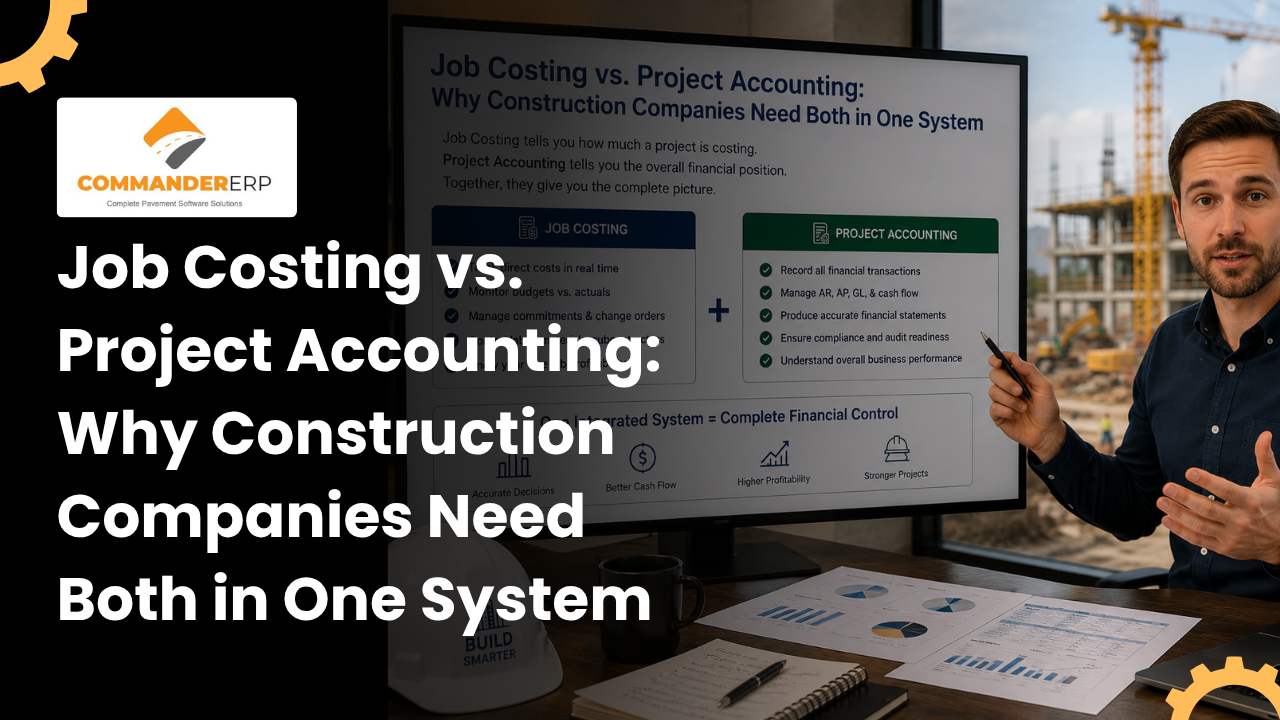
Ask a construction CFO about their biggest challenge and the answer is almost always some version of the same problem: "We don't know the true cost of each project until it's already over."
This is a financial systems problem, and it has a specific cause: most construction businesses either focus too much on job costing without proper accounting integration, or they run standard accounting software that doesn't understand construction's project-by-project structure. The solution is not to choose between them — it's to have both, integrated, in a single system.
This article explains what each discipline does, where they differ, and why combining them in a cloud-based construction ERP is the only way to get accurate financial control.
What Is Job Costing?
Job costing is the practice of tracking all costs — labour, materials, equipment, subcontractors, overheads — against a specific job (project) in real time. The goal is to know, at any given moment, what a specific project has cost to date versus what was budgeted.
In construction, job costing typically covers:
- Direct labour costs (wages, overtime, benefits attributable to the project)
- Material costs (quantity used, wastage, price variance vs. budget)
- Subcontractor costs (claimed amounts vs. agreed contract value)
- Plant and equipment usage (hire costs, fuel, maintenance allocated to the job)
- Indirect or overhead costs allocated based on a predetermined rate
Job costing answers the operational question: Is this project running within budget right now?
What Is Project Accounting?
Project accounting sits at the intersection of finance and project management. It governs how revenue and costs are recognised, reported, and presented in your financial statements in compliance with accounting standards.
Project accounting in construction typically covers:
- Revenue recognition — when and how project revenue is recorded (e.g., percentage of completion method)
- Work-in-progress (WIP) accounting — tracking costs incurred on incomplete projects
- Retention management — accounting for amounts withheld by clients until defects liability expires
- Progress billing — raising invoices against certified work and matching them to cost incurred
- Variation order management — accounting for agreed changes to the contract scope and value
Project accounting answers the financial reporting question: What does this project look like on our books, and are we complying with accounting standards?
Where They Differ — And Why Both Matter
Neither discipline alone gives you complete visibility. Job costing without project accounting leaves finance flying blind. Project accounting without job costing means you only discover budget problems after the damage is done.
| Dimension | Job Costing | Project Accounting |
|---|---|---|
| Primary user | Project Managers, Site Teams | Finance Teams, CFO, Auditors |
| Timing | Real-time, ongoing | Period-end, milestone-based |
| Key question | Are we over/under budget today? | What is the financial position of this project? |
| Revenue focus | Not directly — focuses on cost control | Yes — revenue recognition is central |
| Compliance | Internal management tool | Tied to accounting standards (Ind AS, IFRS) |
| Output | Cost reports, variance analysis | P&L, WIP schedules, cash flow statements |
The Problem with Disconnected Systems
Many construction companies attempt to bridge this gap by running job costing in one tool (a spreadsheet or standalone project management app) and project accounting in a separate accounting package like Tally, QuickBooks, or SAP. The results are predictably problematic:
- Data is manually transferred between systems, creating opportunities for errors and delays.
- Reconciliation between job cost reports and financial statements takes hours and is never fully trusted.
- Variation orders get lost in translation between the project team and finance.
- WIP schedules are assembled once a month rather than maintained continuously.
- The finance team and project team are always arguing about whose numbers are right.
This is not a people problem. It's a systems problem. When job costing and project accounting are in different tools, they will drift — and the resulting confusion undermines trust in financial reporting across the entire organisation.
How Construction ERP Solves This
Single Data Entry, Dual Purpose
In Commander ERP, when a material delivery is received and logged on site, it simultaneously updates the job cost ledger (showing the cost against the project budget) and the accounts payable module (creating the liability to the supplier). One action, two outputs — no manual reconciliation required.
Automated WIP Calculation
Work-in-progress accounting is one of the most complex and time-consuming tasks in construction finance. Commander ERP calculates WIP automatically based on actual costs incurred and the percentage of completion, making period-end reporting significantly faster and more accurate.
Integrated Billing and Revenue Recognition
When a project milestone is certified, Commander ERP enables the project team to generate a progress claim and passes it directly to finance for revenue recognition — correctly, consistently, and without duplication.
Variation Order Tracking Across Both Disciplines
Variation orders are a financial risk in construction. Commander ERP tracks every VO from the moment it's raised — through approval, cost impact, and revised contract value — ensuring job costs and financial accounts always reflect the true agreed scope.
Conclusion
Job costing and project accounting are two sides of the same coin. One keeps your projects under control day to day. The other ensures your financial statements are accurate, compliant, and trustworthy. You cannot afford to manage them separately — the information gaps between disconnected systems are where construction businesses lose money, lose trust, and lose clients.
Commander ERP brings both together in one platform, purpose-built for construction. When your project team and finance team work from the same data, the whole business gets smarter.
Finally Know the True Cost of Every Project
Commander ERP combines real-time job costing and full project accounting in one integrated platform — built specifically for construction businesses.
Book a Free Demo at commandererp.com