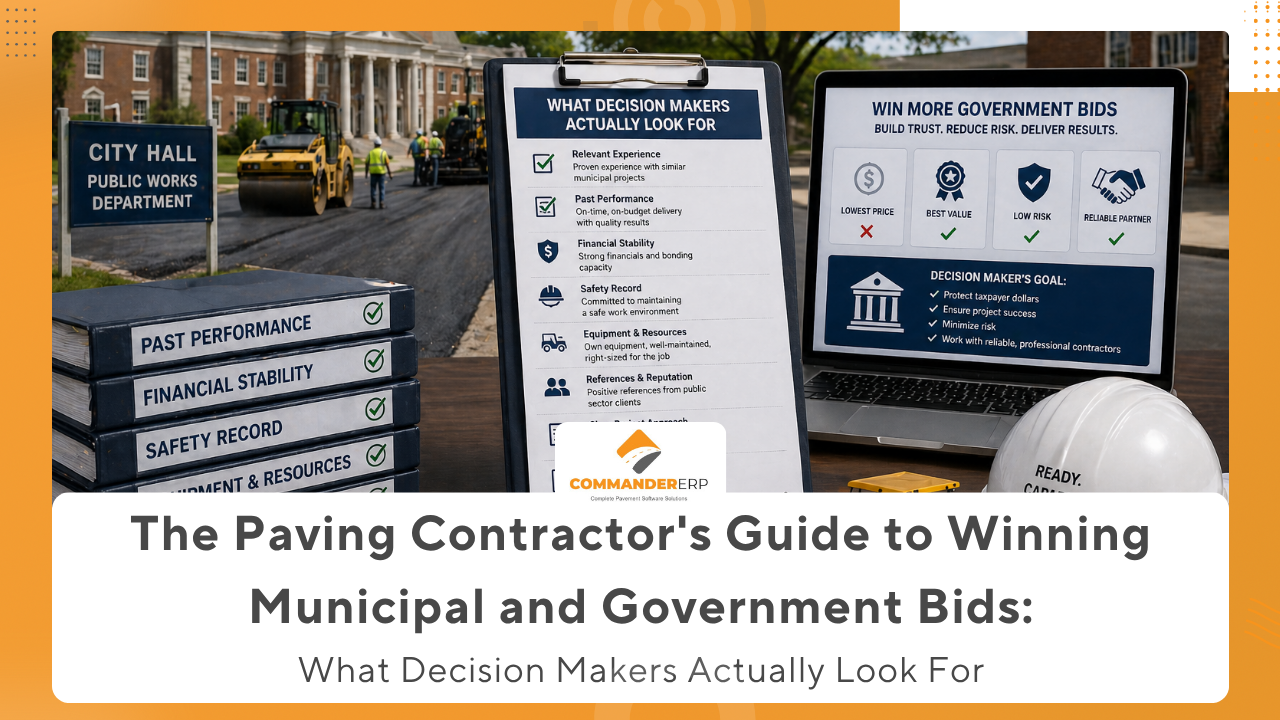
Municipal and government paving contracts are among the most reliable, high-volume opportunities in the industry. They are also among the most misunderstood. Many contractors assume the lowest price wins. It rarely does — at least not on its own. Government procurement officers are trained to assess risk, not just cost. They are accountable for every dollar spent, and their professional reputation depends on choosing vendors who can actually deliver.
Understanding what these evaluators look for — and organizing your business to provide it — is how you consistently win public sector work.
How Government Bidding Differs From Private Work
Private clients often decide based on relationships, reputation, and price. Government procurement is formal, documented, and scored. There are evaluation rubrics. There are compliance requirements. There are public record obligations that make every decision defensible. That formality is actually good news for organized contractors, because it creates clear criteria you can prepare for.
Disorganized contractors — even very skilled ones — lose government bids regularly because their submissions look rushed, incomplete, or uncredible. The technical ability to do the job is table stakes. The ability to prove it on paper is what wins.
What Government Evaluators Actually Score
Documented Past Performance
Evaluators want evidence, not claims. A statement that you have completed hundreds of paving projects means nothing without documentation. A formatted performance report — project name, scope, total value, completion date, client contact — is a completely different submission.Commander ERP generates these reports directly from your job history, so your past performance package is always ready to export.
Financial Stability
Government contracts often require performance bonds, and bonding capacity depends on your financial profile. Evaluators look at revenue consistency, debt levels, and active project backlog. Your ERP financial reporting gives your accountant the clean, organized data they need to present your business favorably to bonding agents and evaluators.
Compliance Documentation
Safety records, insurance certificates, equipment inspection logs, and crew certifications are required for virtually every government bid. When these documents are organized in your ERP, compiling them for a submission takes hours rather than days — and the result is a complete, professional package rather than a frantic assembly of scattered files.
Related Reading: Paving Company Insurance, Bonding & Compliance: How ERP Documentation Keeps You Audit-Ready
Realistic, Defensible Pricing
Government evaluators are sophisticated enough to identify bids that are too low to be credible. Suspiciously cheap submissions raise red flags — they suggest inexperience or a plan to recover margins through change orders. Your ERP cost data helps you build estimates that are competitive, accurate, and supported by line-item detail if questioned.
Structuring a Winning Government Bid Package
A strong municipal bid package includes the following elements:
| # | Bid Package Element |
|---|---|
| 1 | Cover letter that directly addresses the specific scope |
| 2 | Detailed unit-cost price breakdown |
| 3 | Past performance documentation |
| 4 | Equipment and crew capability statement |
| 5 | Current compliance certificates |
| 6 | References with active contact information |
The contractors who win are not always the cheapest — they are the ones who look most capable of delivering without risk. Every element of your bid package should answer the evaluator's unspoken question: can this contractor handle our project and protect us from problems?
Registrations and Certifications to Have in Place
Federal contracts require active SAM gov registration. State and municipal work typically requires state contractor licensing, specific bonding thresholds, and — where applicable — DBE or MBE certification. These need to be maintained year-round, not obtained in the middle of a bidding window.
Treat government readiness as a permanent operational status. When an opportunity opens, you want to be ready to submit within days — not scrambling to renew a lapsed certification.
Building Relationships Before the Bid Window Opens
Government procurement is formal, but familiarity still matters. Attending pre-bid conferences, meeting public works staff, and taking on smaller municipal maintenance contracts — even at thinner margins — builds name recognition. When a major contract opens, evaluators are more comfortable with known quantities than unknown firms, even if both meet the technical criteria.
Related Reading: How Paving Contractors Can Use ERP Data to Win Repeat Clients and Referrals
Making Government Bidding a Repeatable System
Contractors who win government work consistently have turned the process into a system. Their past performance documents are always current. Their equipment lists are accurate. Their compliance certificates are organized with expiration reminders. They respond to bid opportunities in days rather than weeks.
- Keep SAM.gov and all state registrations current year-round — set renewal reminders in your ERP
- Maintain a live equipment inventory in ERP so capability statements are always accurate
- Update your past performance log after every project closes — do not reconstruct it at bid time
- Store all compliance certificates in your ERP document center with expiration alerts
- Attend at least two municipal pre-bid conferences per season to establish familiarity with procurement staff
Ready to win more government paving contracts?
Organized data and credible submissions start with the right operational infrastructure.
Book a Commander ERP DemoConclusion
Municipal and government paving work goes to the most credible firm, not just the cheapest. When your operations are documented, your compliance is current, and your past performance is organized and exportable — you enter every public bid as a serious, well-prepared contender.
Commander ERP is the operational infrastructure that makes that credibility possible.
